Quick identification facts
Wood Tick vs Dog Tick Visual Identifier
Check the visible features of your tick specimen to confirm whether it matches the American dog tick, the brown dog tick, or another common outdoor look-alike.
Are Wood Ticks and Dog Ticks the Same Thing?
When you hear someone mention a wood tick in the eastern half of North America, they are almost always talking about the American dog tick. The common name wood tick has stuck around for generations as a catch-all term for any large, hard-bodied tick found crawling through brush. Because common names vary widely by county and state, this shared nickname often creates confusion when you try to identify a specimen you found on your pet or clothing.
The American dog tick has a massive geographic distribution that spans from the Atlantic coastal states all the way west to the Rocky Mountain region. It also lives along parts of the Pacific coast, including California, Oregon, Washington, and sections of Canada and Mexico. Because it thrives in so many outdoor environments, local populations have simply inherited regional nicknames, with wood tick remaining the most frequent label in rural and suburban communities.
You will find that scientific references use precise Latin names to prevent this confusion entirely. Dermacentor variabilis designates the American dog tick, while Dermacentor andersoni designates the Rocky Mountain wood tick. Knowing which specific creature you are looking at comes down to checking the physical markings on the back plate, known as the scutum, and noting the exact geographical setting where you collected the specimen.
- Wood tick serves as a popular regional nickname for the American dog tick in eastern North America.
- American dog ticks live across Atlantic states, western regions, the Pacific coast, Canada, and Mexico.
- Latin names separate the American dog tick from the distinct Rocky Mountain wood tick.
For another part of the identification, open Dog Tick vs Deer Tick: What's the Difference?.
What Does the American Dog Tick Look Like?
You can recognize an adult American dog tick by its dark reddish-brown base color accented with pale, ornate patterns. Unlike plain species, both males and females carry noticeable white or cream markings on their dorsal shield, or scutum. Unfed adults are flat, oval, and possess eight legs, while tiny larvae emerge with only six legs before molting into eight-legged nymphs and adults.
The pattern on the scutum tells you the sex of the tick immediately. On an adult female American dog tick, the cream or off-white scutum covers only about the front third of the body against the dark brown background. This leaves the back two-thirds of her body free to expand significantly after a blood meal. On an adult male, the scutum extends over the entire dorsal surface, displaying a mottled cream-and-gray pattern across his whole back.
Another reliable detail you can check along the rear edge of the abdomen is a row of small, segmented notches called festoons. These distinct grooves line the outer rim of unfed adults. If a female feeds until she is fully engorged, her body swells and changes appearance completely, stretching outward until she resembles a smooth, swollen, dark pinto bean.
- Adult females have a short, off-white scutum covering the front third of the body.
- Adult males feature a mottled cream-and-gray scutum covering their entire dorsal surface.
- The rear abdominal rim displays segmented notches called festoons.
To compare this detail with another source, BugKnow’s dog tick page offers a useful cross-check.
How Does the Brown Dog Tick Differ?
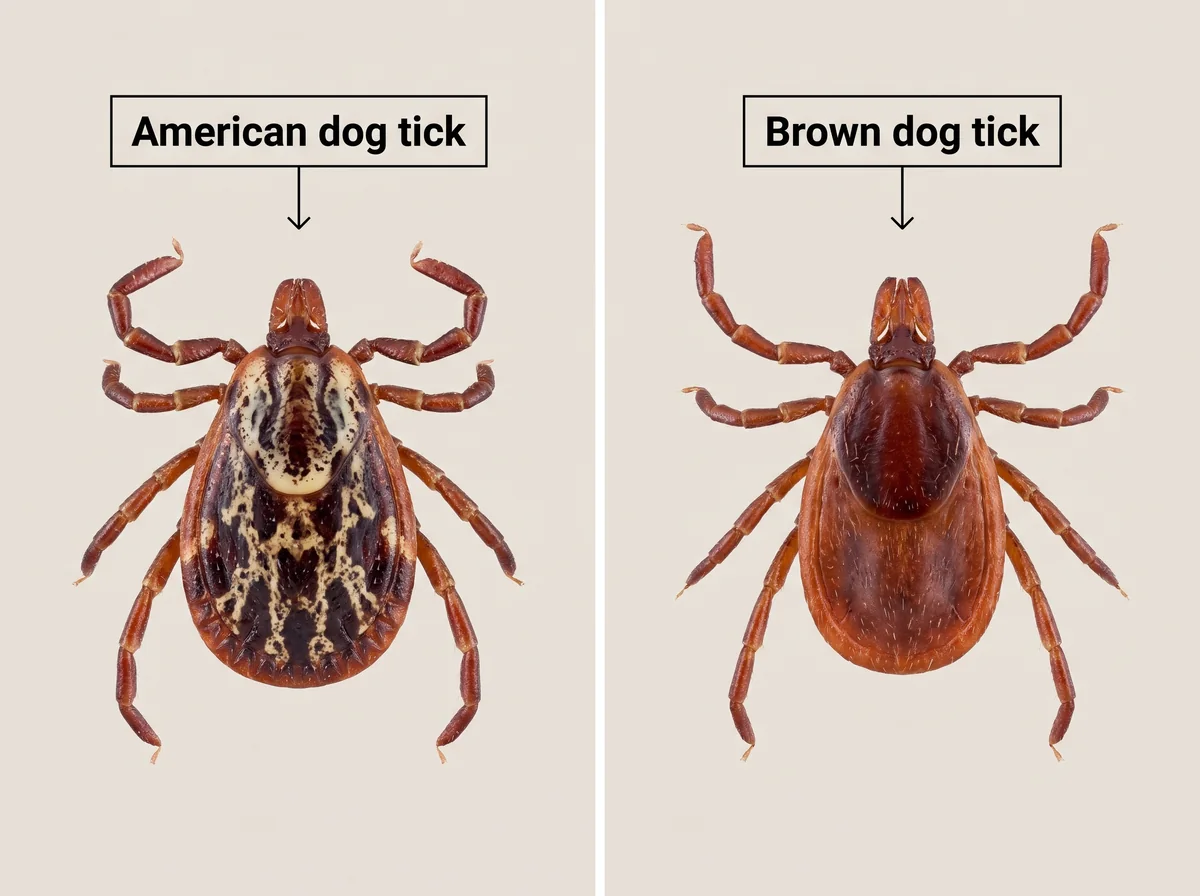
You might also encounter the brown dog tick, which belongs to a completely different genus than the American dog tick. While American dog ticks are decorated with prominent cream-colored patches, brown dog ticks are uniformly reddish-brown with no distinctive mottled markings on their backs. This solid coloring makes them look much plainer when you view them under direct light or through a magnifying lens.
The brown dog tick shows similar sexual division in shield size, though without any contrasting pattern. On male brown dog ticks, the solid reddish-brown scutum covers the entire dorsal surface. On females, that same plain scutum covers only the area located directly behind the mouthparts. Because neither sex has white enamel markings, you can easily separate them from the ornate American dog tick.
Geographic habits and living quarters also set these two apart. Brown dog ticks are found worldwide and throughout the entire United States, including Hawaii. Unlike American dog ticks, which require outdoor terrain, brown dog ticks thrive indoors. In the Northeast, they are found almost exclusively inside human dwellings and dog kennels, hiding along baseboards, window moldings, wall gaps, and furniture.
- Brown dog ticks have solid reddish-brown bodies with no cream or mottled markings.
- Male brown dog ticks have full-body dorsal shields, while females have short shields behind the head.
- Brown dog ticks live worldwide and readily complete their entire life cycle inside homes and kennels.
You can check the same detail against American Dog Tick Identification: What Does It Look Like?.
Where Do Wood Ticks and Dog Ticks Live Outdoors?
American dog ticks thrive predominantly along sunny forest edges and in exposed outdoor areas with little to no tree cover. You are most likely to encounter them crawling along grassy fields, coastal scrubland, walkways, unpaved sidewalks, and maintained hiking trails. They climb up low vegetation and wait for potential hosts to brush against the stems, rather than dropping down from tall tree canopies.
Host preferences shift as the tick grows through its life cycle. Larvae and nymphs of the American dog tick feed mainly on small wild mammals, including field mice, voles, and chipmunks that scurry through ground-level runways. Once they reach the adult stage, these ticks switch their attention to medium-to-large hosts, actively seeking out domestic dogs, raccoons, coyotes, and passing humans.
By contrast, the true Rocky Mountain wood tick occupies higher elevations and shrublands throughout western states and provinces. Understanding the surrounding landscape helps you narrow down which tick is active in your area. If you are walking through open eastern meadows or trail edges, you are dealing with the American dog tick regardless of whether your neighbors call it a wood tick.
- American dog ticks concentrate along sunny forest edges, trail borders, and open grassy fields.
- Immature life stages feed on small rodents like mice and voles before targeting larger hosts.
- Adult American dog ticks seek medium-to-large hosts, including dogs, raccoons, and people.
How Do Dog Ticks Compare to Deer Ticks?
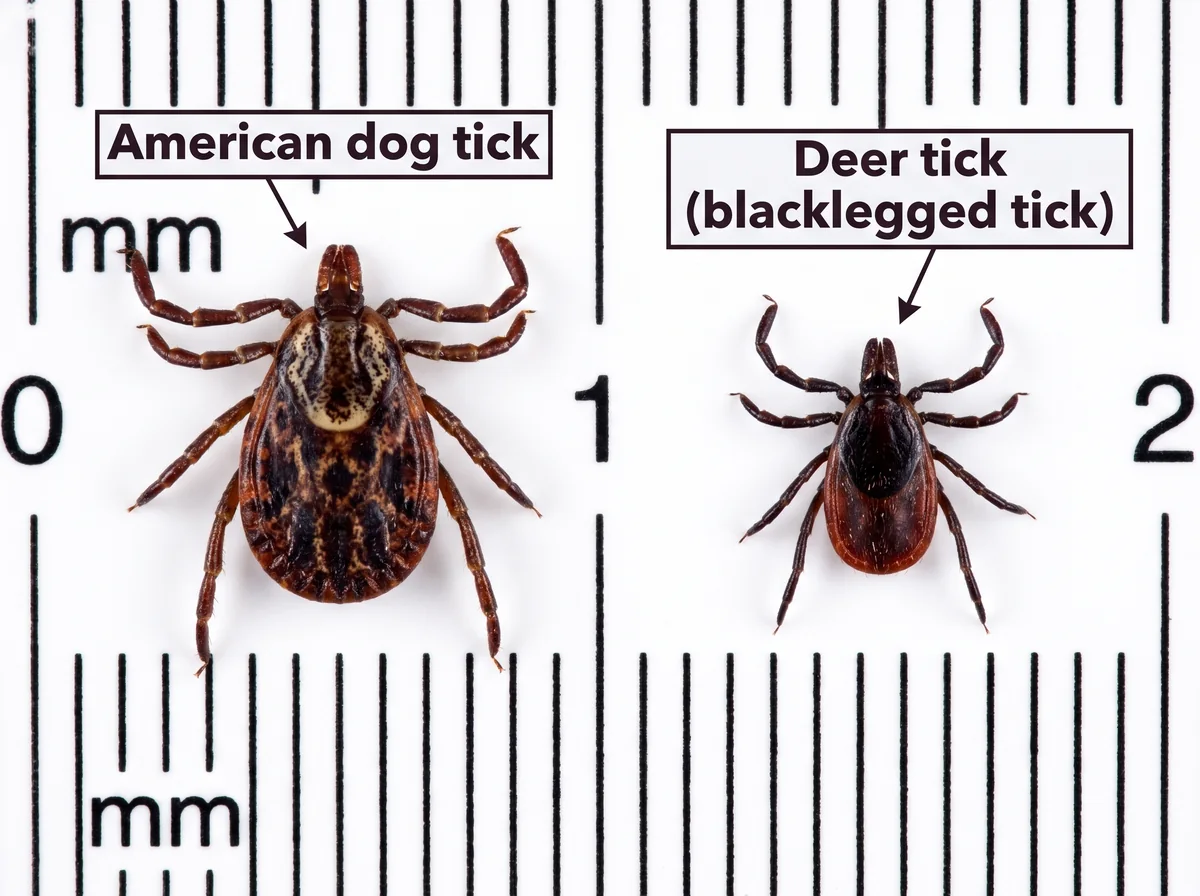
Telling a dog tick apart from a deer tick, also known as the blacklegged tick, is straightforward once you examine coloration and patterns. Deer ticks have a solid dark brown to black shield and dark legs, with adult females displaying an orange-red abdomen behind the scutum. They completely lack the ornate cream, white, or silvery marbling that you see on the American dog tick.
Size provides another obvious clue when you place specimens side by side. Adult American dog ticks are noticeably larger and broader than deer ticks in both unfed and fed states. Deer ticks are notoriously tiny, often compared to the size of a sesame seed or poppy seed during their immature stages, whereas adult dog ticks present a wider, more visible profile on clothing or fur.
Their outdoor environments also diverge sharply. Deer ticks prefer the deep leaf litter and humid interior shade of mature deciduous forests. American dog ticks avoid dense canopy shade, choosing open brush, tall grasses, and sunlit paths instead. Examining the body pattern and the exact place where you picked up the tick will tell you which species you have encountered.
- Deer ticks lack the cream or off-white mottled patterns found on American dog ticks.
- American dog ticks are broader and visibly larger than blacklegged deer ticks.
- Deer ticks favor deep woodland leaf litter, while dog ticks prefer open, sunlit paths and fields.
For another part of the identification, open Dog Tick Habitat: Where Does It Live?.
Related identification guides
American Dog Tick Identification: What Does It Look Like?
identify the American dog tick specifically by color, shield pattern, and size
comparisonDog Tick vs Deer Tick: What's the Difference?
tell a dog tick apart from a deer tick
otherDog Tick Size: How Big Is It?
find exact size measurements for dog ticks unfed and engorged, at every life stage
habitatDog Tick Habitat: Where Does It Live?
understand where dog ticks live outdoors and how dogs pick them up
Frequently asked questions
Is a wood tick the same as an American dog tick?
Yes, in most everyday situations across the eastern and central United States, wood tick is simply a regional name for the American dog tick. Both names point to the same reddish-brown species with cream-colored markings. In western mountainous regions, wood tick may refer to the Rocky Mountain wood tick, a separate species that shares a similar ornate appearance.
Can dog ticks live and reproduce inside your home?
American dog ticks rarely survive indoors because they require high humidity and outdoor vegetation to complete their life cycle. However, brown dog ticks are strongly adapted to human dwellings. They readily live inside homes and dog kennels, laying eggs and hiding inside wall gaps, along baseboards, and behind window moldings across all regions of North America.
How do you identify a female American dog tick?
You can identify an adult female American dog tick by looking at the hard plate on her back. Her cream or off-white scutum covers only the front third of her body, positioned right behind her mouthparts. The remaining two-thirds of her back is solid reddish-brown, allowing her abdomen to expand significantly when taking a blood meal.
What does an engorged dog tick look like?
When an adult female American dog tick takes a full blood meal, her appearance changes dramatically. Her body expands outward into a rounded, swollen shape that closely resembles a dark, gray-to-brown pinto bean. The small cream-colored scutum remains unchanged at the front, but the rest of her body stretches into a smooth, tense oval.