Quick identification facts
Dog Tick Life Stage Identifier
Use these observable physical and behavioral checks to determine which life stage of the dog tick you are examining.
What Are the Four Life Stages?
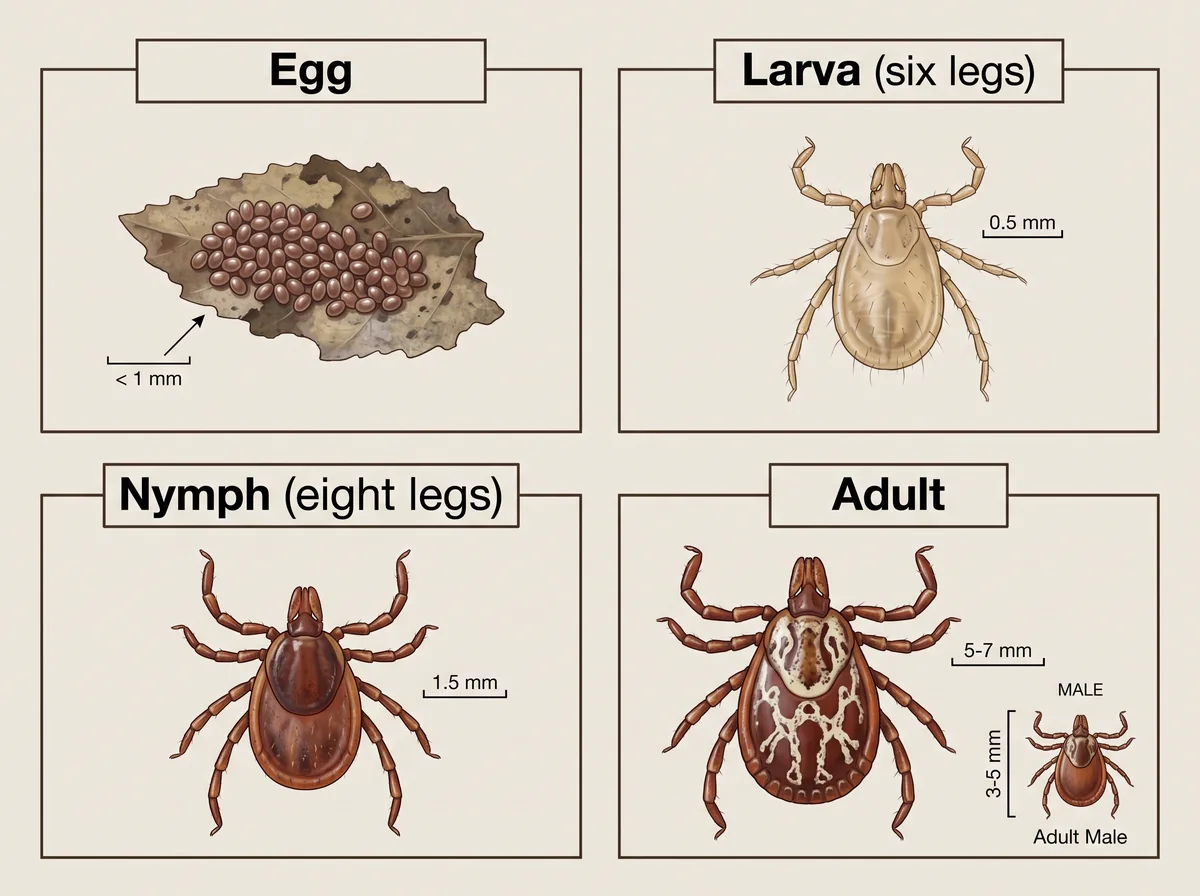
The life cycle of the American dog tick begins when an adult female deposits eggs outdoors. Once the eggs hatch, tiny six-legged larvae emerge to begin searching for their first meal. After feeding and dropping off the host, these larvae shed their outer skin and transform into eight-legged nymphs, which look like miniature versions of the mature adults you might spot on your pet.
Nymphs must secure their own blood meal before they can molt a second time into fully formed adult ticks. As adults, both males and females retain eight legs and develop mature reproductive organs. Female ticks require one final, extensive blood meal to produce eggs, while males take smaller meals to support mating activity before the generation comes to an end.
You can easily separate the earliest stage from older ticks simply by counting their legs under good lighting. Larvae always possess six legs, whereas nymphs and unfed adults consistently display eight. Recognizing these physical transitions helps you track which developmental phase is active in your yard during different months of the year.
- Egg: Laid outdoors in protective leaf litter during late summer or fall.
- Larva: Tiny six-legged form that hatches and overwinters before feeding.
- Nymph: Eight-legged growing stage that requires a second independent blood meal.
- Adult: Fully developed eight-legged stage focused on final feeding and reproduction.
This also connects with Dog Tick Eggs: What Does It Look Like?.
How Does the Three-Host Pattern Work?
The American dog tick is classified as a three-host tick, which means it requires three separate animal hosts to complete its life cycle. A tick feeds on an animal during the larval stage, detaches to molt in the soil, finds a completely new animal as a nymph, detaches again, and finally seeks a third host as an adult.
This feeding strategy means an individual tick spends most of its life living freely in the environment rather than attached to an animal. Each active stage must climb vegetation, wait for a suitable host to brush past, attach firmly, feed over several days, and drop back into surface debris. If you find a tick crawling on your clothes, it is actively searching for that stage's host.
Unlike the American dog tick, the brown dog tick can complete its entire three-host cycle inside your home or kennel. While both species feed on three successive hosts across their active stages, the brown dog tick's unique ability to thrive indoors allows it to establish persistent populations in your living spaces without needing outdoor leaf litter.
- Host 1: Larva attaches, feeds to repletion, and drops to the ground to molt.
- Host 2: Nymph emerges, searches for a second host, feeds, and drops off.
- Host 3: Adult attaches to a third host to mate and take its final meal.
A related clue is covered in Dog Tick Larvae and Nymphs: What Should You Know?.
For another set of photos and notes, Insectio’s dog tick eggs page is worth comparing.
How Long Does Full Development Take?
Under normal outdoor conditions across North America, the American dog tick typically requires about two full years to progress from an egg to a reproducing adult. Cold winters, dry summer spells, and the challenge of locating an available host at each stage naturally slow down their developmental rate in your local area.
The total duration can vary widely depending on local temperature, relative humidity, and host availability. In field conditions, the cycle can span anywhere from three months up to three full years. Under optimal laboratory settings with constant warmth and immediate access to feeding, researchers have observed the entire cycle finishing in as few as 54 days.
A major factor in this multi-year timeline is the tick's remarkable ability to endure prolonged starvation between meals. Unfed adult American dog ticks can survive in quiet outdoor shelters for up to two years—roughly 1,000 days maximum—while waiting for you or a passing animal to brush against their perch.
- Typical field duration: Roughly 2 years under seasonal weather patterns.
- Observed natural range: 3 months to 3 years based on climate and host access.
- Ideal laboratory speed: Completed in as little as 54 days without environmental delays.
- Adult survival limit: Up to roughly 1,000 days without taking a blood meal.
A related clue is covered in Dog Tick Season: What Should You Know?.
Where Do Females Lay Their Eggs?
Once an adult female American dog tick mates and feeds to complete engorgement, she detaches from her final host and drops to the ground. She does not lay her eggs on your dog or on any other animal. Instead, she seeks sheltered ground cover in fallen leaves and dense brush where moisture levels stay high.
Egg-laying typically occurs in late summer or fall within protective leaf litter and organic surface debris around your property. Depositing the egg mass directly into soil litter keeps the developing eggs sheltered from harsh sunlight and drying winds. After finishing her single massive egg clutch, the exhausted female dies, leaving the eggs to hatch on the ground.
Larvae generally hatch during the same season the eggs were laid, resting quietly through the colder months within the moist duff layer. When warmer spring weather arrives, you may notice these tiny six-legged larvae emerging from the leaf litter to begin questing for their very first blood meal on small ground animals.
- Off-host laying: Eggs are deposited strictly on the ground, never on an animal host.
- Preferred habitat: Moist leaf litter, organic surface debris, and sheltered ground cover.
- Seasonal timing: Oviposition occurs primarily in the fall following final adult engorgement.
- Overwintering strategy: Newly hatched larvae remain protected in litter until spring.
For the next useful comparison, see Engorged Dog Tick: What Should You Know?.
Why Is a Blood Meal Required at Every Step?
Blood provides the vital protein, water, and nutrients that fuel every physical transition in the tick's life. A larva cannot transform into a nymph without consuming a full meal of blood to power the molting process. Similarly, a nymph cannot develop adult structures or reproductive organs without ingesting another complete meal.
For adult females, the final blood meal serves a reproductive purpose rather than a molting trigger. The female must consume substantial amounts of host blood to nourish and develop thousands of viable eggs within her body. Without this concentrated source of nutrition, she cannot produce or deposit a successful egg mass in your yard.
Because ticks must feed at every active life stage, they create multiple opportunities across their two-year lifespan to acquire and transmit pathogens. If a tick picks up an infectious agent while feeding as a larva or nymph, it can retain that organism through the molt and potentially pass it along when it bites you or your pet during its next feeding stage.
- Larval molt: Blood meal triggers cellular remodeling into an eight-legged nymph.
- Nymphal molt: Blood nutrients drive development of adult anatomy and sex organs.
- Adult egg production: Female requires a massive final meal to mature her egg clutch.
- Pathogen transfer: Feeding at three separate stages allows disease transmission across molts.
You can check the same detail against Dog Tick Bite Identification: What Does It Look Like?.
Related identification guides
Dog Tick Eggs: What Does It Look Like?
identify tick eggs and understand whether ticks lay eggs directly on a dog
appearanceEngorged Dog Tick: What Should You Know?
identify a full, blood-fed tick found on a dog
appearanceDog Tick Larvae and Nymphs: What Should You Know?
identify immature dog tick life stages that are often mistaken for other insects
seasonalityDog Tick Season: What Should You Know?
learn the seasonal activity pattern of dog ticks
Frequently asked questions
Can a dog tick complete its entire life cycle indoors?
The American dog tick rarely completes its life cycle indoors because it requires outdoor humidity and natural leaf litter to survive between molts. In contrast, the brown dog tick is uniquely adapted to warm, dry indoor environments and can complete all three feeding stages inside your home or kennel.
What happens to adult ticks after they mate and lay eggs?
Adult female American dog ticks die shortly after depositing their single large egg mass in outdoor leaf litter. Male ticks may survive slightly longer to mate with multiple females, but neither sex survives long after completing their final reproductive functions in your yard.
How do larvae survive the winter before finding a host?
Larvae hatch in late summer or fall and burrow into moist leaf litter, soil crevices, and organic surface debris. This protective insulating layer shields them from extreme temperatures and drying winds, allowing them to remain dormant until spring temperatures rise in your area.
How can you tell a tick larva from a tick nymph?
The most reliable visual difference is leg count. Larvae possess only six legs when they hatch from the egg. After taking a blood meal and completing their first molt, nymphs emerge with eight legs, which they retain through the adult life stage.