Quick identification facts
Dog Tick Disease Risk Checker
Review these observable tick and bite characteristics to assess potential disease exposure risks from a dog tick encounter.
Which Major Diseases Do American Dog Ticks Transmit?
The American dog tick poses the greatest medical risk to humans through the transmission of Rocky Mountain spotted fever. In the eastern United States, this tick serves as the primary vector for the bacterium responsible for the illness. When you find an attached tick, noting its physical markings helps assess what pathogens it might carry.
Tularemia is another serious bacterial disease that American dog ticks can spread to both humans and animals. While less common than spotted fever, tularemia can cause painful skin ulcers and swollen lymph glands. You should monitor any bite location closely over the days following an outdoor exposure.
In rare situations, secretions from feeding American dog ticks can also cause canine tick paralysis in dogs. This condition occurs when a female tick feeds for an extended period, releasing a neurotoxin into your pet. Prompt removal of the feeding tick typically halts the progression of the paralysis.
- Transmits the bacteria that cause Rocky Mountain spotted fever
- Spreads tularemia to people and domestic animals
- Can cause canine tick paralysis during prolonged feeding
You can check the same detail against Dog Tick Bite Identification: What Does It Look Like?.
How Dangerous Is Rocky Mountain Spotted Fever?
Rocky Mountain spotted fever ranks among the deadliest tick-borne diseases in North America when left untreated. Medical records indicate that untreated cases have a mortality rate exceeding 20 percent. If you or your pet develop sudden fevers or muscle aches after a bite, immediate evaluation is essential.
The disease progresses rapidly once symptoms begin, often starting with high fever, severe headache, and deep muscle pain. A characteristic rash often develops several days later, though its appearance varies widely between individuals. Knowing your exposure history helps medical providers choose the appropriate course of action promptly.
Larval American dog ticks can emerge from eggs already infected with the bacteria through transovarial transmission. This means an overwintering larva does not need to feed on an infected rodent to become dangerous to you. Even early-stage ticks in your yard can theoretically harbor the infectious pathogen from birth.
- Untreated cases carry a mortality rate higher than 20 percent
- Symptoms often include rapid fever, headache, and a distinct rash
- Transovarial transmission allows newly hatched larvae to carry bacteria
You can check the same detail against Dog Tick Prevention: How Can You Avoid It?.
To compare this detail with another source, Insectio’s dog tick page offers a useful cross-check.
What Health Risks Do Brown Dog Ticks Pose to Pets?
Brown dog ticks present a unique hazard because they feed readily on dogs across all life stages. These uniformly reddish-brown ticks transmit Ehrlichia canis, which leads to canine ehrlichiosis. You may notice lethargy, weight loss, or nosebleeds in your dog if this blood parasite takes hold.
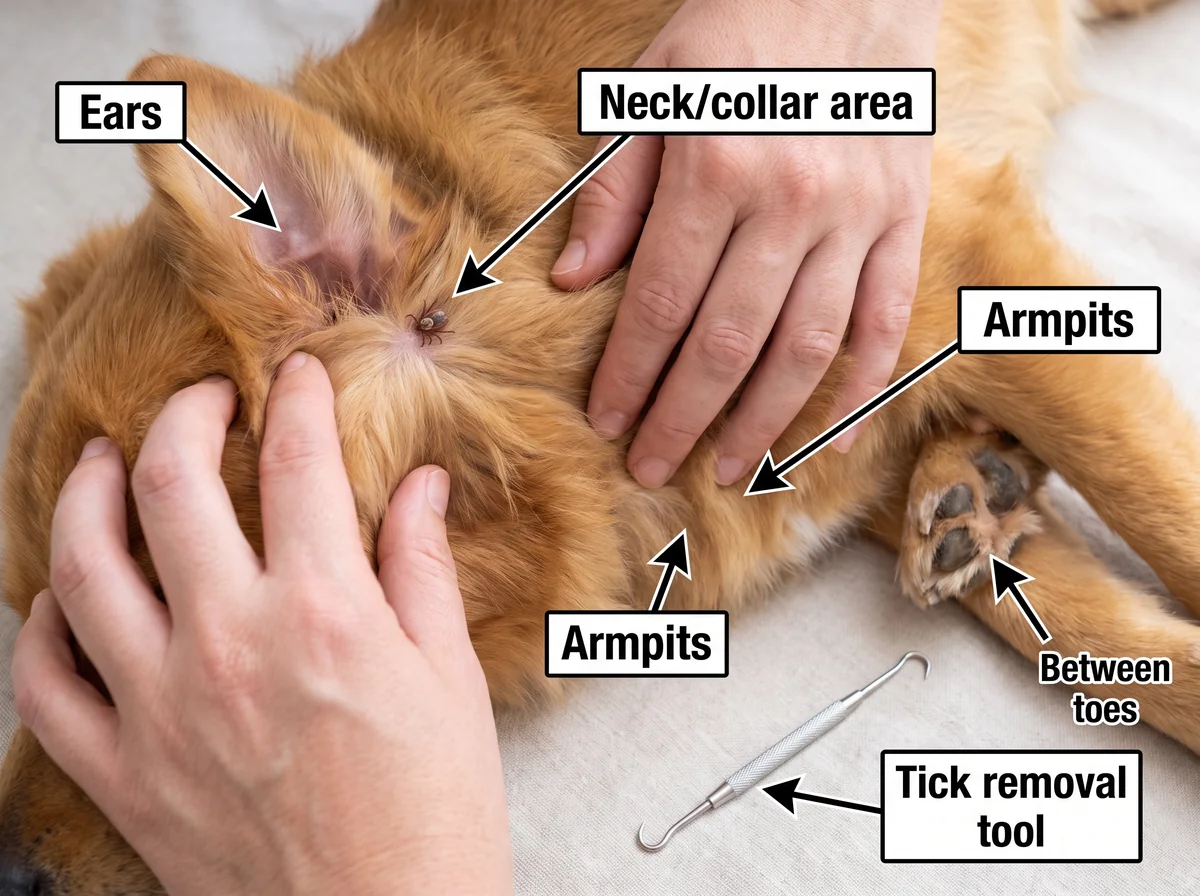
Another significant threat carried by the brown dog tick is Babesia canis, the organism responsible for canine babesiosis. This microscopic parasite attacks red blood cells, leading to severe anemia and pale gums in affected animals. Regular checks across your dog's ears and toes help spot these parasites early.
Recent health investigations have also identified the brown dog tick as an active vector of Rocky Mountain spotted fever in the southwestern United States. Along the regional border, these ticks can pass spotted fever to both dogs and human family members. Keeping your living areas inspected reduces these multi-host hazards.
- Transmits Ehrlichia canis, the cause of canine ehrlichiosis
- Spreads Babesia canis, which attacks your pet's red blood cells
- Acts as an RMSF carrier in southwestern border regions
For another part of the identification, open Brown Dog Tick Identification: What Does It Look Like?.
Can Dog Ticks Transmit Lyme Disease?
A widespread misconception is that all outdoor ticks spread Lyme disease, but dog ticks do not carry this organism. Lyme disease is spread strictly by blacklegged ticks, commonly known as deer ticks. When you find an American dog tick or brown dog tick on your body, Lyme disease is not a risk.
You can tell dog ticks apart from deer ticks by examining their size and distinctive dorsal markings. Adult dog ticks are roughly double the size of deer ticks and feature cream markings or dark unpatterned shields. Deer ticks have solid dark brown or black legs and unornamented shields without white patterns.
Recognizing these visual differences prevents unnecessary confusion regarding which specific illnesses you need to watch for. Even though dog ticks do not spread Lyme disease, you still need to guard against spotted fever and tularemia. Careful identification ensures you monitor the correct symptoms after a bite.
- Neither American nor brown dog ticks carry Lyme disease
- Blacklegged deer ticks are roughly half the size of adult dog ticks
- Dog ticks display patterned or plain reddish shields rather than solid black
You can check the same detail against Dog Tick Season: What Should You Know?.
How Long Must a Dog Tick Feed to Spread Disease?
Dog ticks are notoriously slow feeders that remain attached for several days to complete a full blood meal. Pathogen transmission is rarely instantaneous when a tick first pierces your skin. The bacteria usually require several hours of steady attachment before passing into the host bloodstream.
A flat tick that you discover crawling across your clothes or lightly attached has likely not transmitted pathogens. As a female American dog tick feeds, her body expands dramatically until she resembles a dark pinto bean. If you find a fully engorged tick, the probability of pathogen transmission is substantially higher.
Checking your pets and outdoor gear immediately after coming inside gives you a wide safety window to remove attached parasites. Because the transmission window spans multiple hours, prompt discovery protects you from serious harm. Always preserve the removed specimen in a sealed container for accurate identification if symptoms appear.
- Bacterial transmission typically takes hours of continuous attachment
- Crawling or unengorged ticks pose a much lower risk of pathogen spread
- Fully engorged ticks resembling pinto beans indicate prolonged feeding
This also connects with Removing a Tick from a Dog: What Should You Know?.
Related identification guides
Brown Dog Tick Identification: What Does It Look Like?
identify the brown dog tick and understand its indoor habits
signsDog Tick Bite Identification: What Does It Look Like?
identify a fresh or healing dog tick bite mark on skin
preventionDog Tick Prevention: How Can You Avoid It?
find general, safe ways to prevent ticks on dogs
seasonalityDog Tick Season: What Should You Know?
learn the seasonal activity pattern of dog ticks
Frequently asked questions
Can an American dog tick bite make you sick immediately?
No, dog ticks do not transmit pathogens immediately upon biting. They are slow feeders, and bacterial transmission usually takes several hours of sustained attachment. If you remove an unengorged tick promptly after outdoor activity, the chance of illness is very low. However, you should still monitor your bite site for redness, rash, or fever over the following two weeks.
How do you know if a tick on your dog is a brown dog tick or an American dog tick?
You can separate the two species by looking closely at the shield behind the mouthparts. American dog ticks have distinct off-white or cream mottled patterns across their dark brown base, while brown dog ticks are uniformly reddish-brown without pale markings. Both species have eight legs as adults and distinct festoons along their rear margins.
What should you do if your dog shows weakness after a tick bite?
If your dog develops weakness or loss of coordination after finding an attached American dog tick, suspect canine tick paralysis. This rare condition is caused by a neurotoxin released during prolonged tick feeding. You should carefully remove the tick immediately, which typically halts the paralysis, and consult your veterinarian for supportive medical care and evaluation.
Do dog tick larvae carry diseases before their first blood meal?
Yes, American dog tick larvae can hatch already infected with Rocky Mountain spotted fever bacteria due to transovarial transmission from the mother. While six-legged larvae primarily feed on small wild rodents rather than people, they can introduce pathogens into local animal populations immediately. As they molt into eight-legged nymphs and adults, they retain these harmful bacteria.