Quick identification facts
Dog Tick vs Deer Tick Identifier
Use these visual checks to determine whether the tick you found is an American dog tick or a blacklegged deer tick.
How Do Their Sizes Compare in Person?
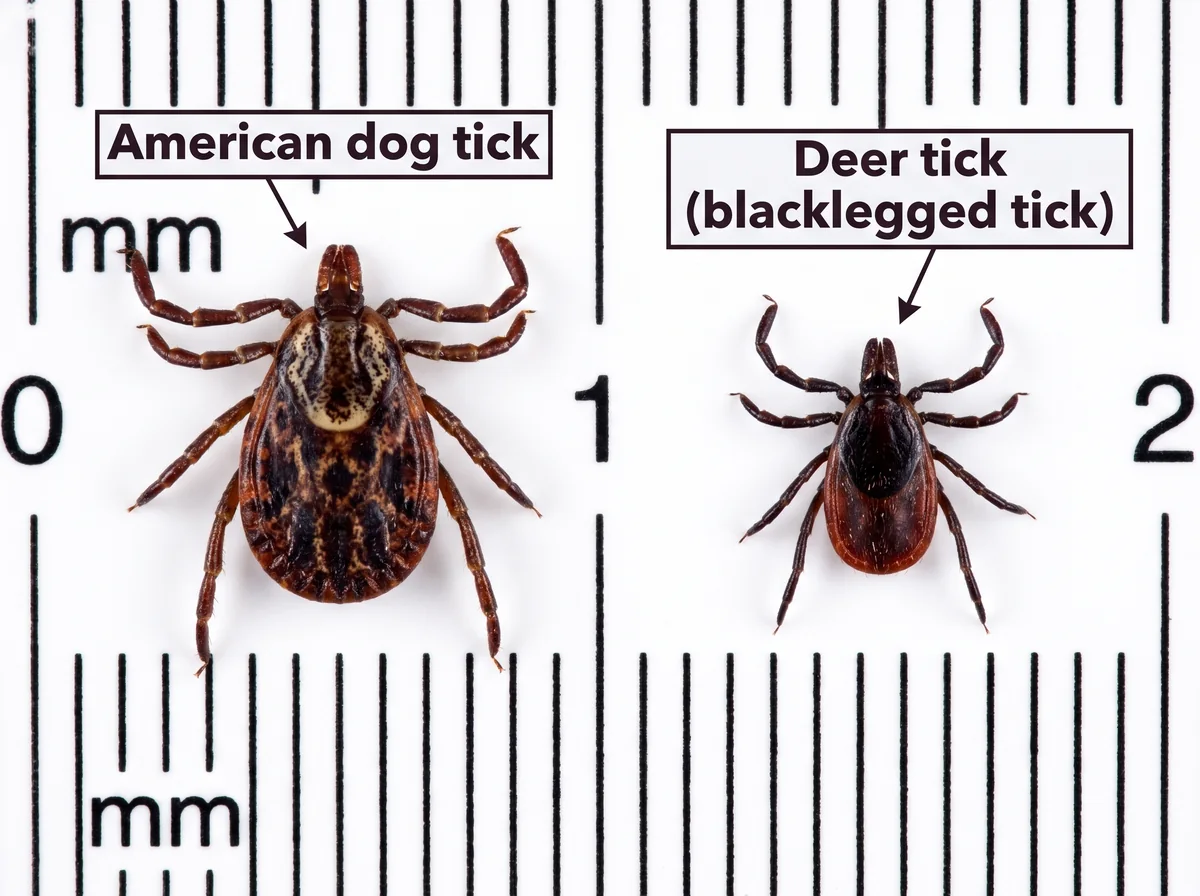
When you look at an unfed tick on your clothing or pet, size offers an immediate clue. Unfed adult dog ticks are roughly double the size of deer ticks. An unfed adult American dog tick measures about one-quarter inch long, making it easy to spot with the naked eye. In contrast, deer ticks are tiny, frequently described as the size of a sesame seed or even smaller during their immature nymphal life stages.
The exact measurements highlight this clear physical gap between the two species. Unfed adult male American dog ticks average about 1.43 millimeters long and 1.01 millimeters wide. Unfed adult females are slightly larger, averaging about 3.8 millimeters in length and 2.5 millimeters across. Because deer ticks are so much smaller at every life stage, finding a larger, broad tick crawling across your dog usually points directly toward a dog tick.
Immature dog ticks are also noticeably small, though they are rarely found on humans. American dog tick larvae are pinhead-sized, measuring around 0.60 millimeters long and 0.40 millimeters wide. Nymphs grow to roughly twice that size, measuring about 0.9 millimeters by 0.8 millimeters. If you capture a specimen that is flat, wide, and around a quarter inch, you are almost certainly looking at an adult dog tick rather than a deer tick.
- Unfed adult dog ticks reach about 1/4 inch long.
- Deer ticks are roughly half that size, resembling small sesame seeds.
- Dog tick larvae are pinhead-sized at roughly 0.60 mm long.
This also connects with Wood Tick vs Dog Tick: What's the Difference?.
What Markings Distinguish the Shields and Backs?
The color pattern on the scutum, which is the hard protective shield on the tick's back, is the most reliable visual identifier. Adult American dog ticks are reddish-brown with distinct off-white or cream markings across their dorsal surface. Adult deer ticks do not share these cream-colored patterns. If you examine the tick closely under good lighting, these light markings immediately rule out a blacklegged deer tick.
Male and female dog ticks display their cream markings differently across their backs. On adult female American dog ticks, the cream or off-white scutum covers only about the front third of the body against a dark reddish-brown background. On adult males, the hard scutum extends across the entire dorsal surface, displaying a diffuse mottled cream-and-gray pattern. This mottling gives the male a decorative, patterned appearance.
You can also check the outer margin of the tick's body for small structural divisions. The American dog tick's abdomen features festoons, which look like small rectangular or segmented notches lining the rear edge of the body. In contrast, brown dog ticks are uniformly reddish-brown without cream markings. Checking the rear festoons and shield markings lets you accurately separate American dog ticks from both deer ticks and brown dog ticks.
- Females have a cream shield covering the front third of their body.
- Males feature a mottled cream-and-gray pattern over their entire back.
- Festoons create segmented notches along the outer rear rim of the abdomen.
If you want a second reference, BugKnow’s deer tick vs. dog tick page covers the same topic from another angle.
How Does Leg and Body Structure Differ?
Examining leg count and body shape helps you determine both the species and the current life stage of the tick. Unfed adult and nymphal dog ticks have eight legs, while tiny newly hatched larvae have only six legs. The legs of an American dog tick are reddish-brown, blending naturally into the base color of the body. Deer ticks are often called blacklegged ticks because their dark legs contrast sharply against their abdomen.
The body shape of a flat, unfed dog tick is broad and oval. When looking down from above, the mouthparts of a dog tick appear short and blunt compared to the longer, more prominent mouthparts of a deer tick. This compact front profile gives dog ticks a sturdier, wider appearance. If the tick you pulled from your pet has distinct reddish-brown legs and short mouthparts, it matches dog tick anatomy.
Brown dog ticks share this general eight-legged adult structure but lack decorative back patterns entirely. Male brown dog ticks have a plain reddish-brown scutum covering their whole back, while females have a small reddish-brown shield behind the head parts. Neither dog tick species features the distinctly blackened legs seen on adult deer ticks, making leg tone a helpful secondary check during your visual inspection.
- Adults and nymphs have eight legs, whereas tiny larvae possess six.
- Dog tick legs are reddish-brown rather than contrasting black.
- Mouthparts on dog ticks are short and blunt compared to deer ticks.
This also connects with Dog Tick Diseases: What Should You Know?.
What Happens When a Female Dog Tick Engorges?
When an adult female dog tick feeds on a host, its body expands dramatically, which alters its shape and color. A fully engorged female American dog tick can swell up to about 15 millimeters long and 10 millimeters wide, sometimes weighing over 1 gram. At this fully fed stage, the tick can expand up to half an inch or larger, which is drastically bigger than an engorged deer tick.
As the female takes in blood, the abdomen stretches and turns a slate gray or dark olive tone. A blood-fed female American dog tick frequently resembles a smooth, dark pinto bean embedded in the skin or fur. Because the abdomen expands outward and backward, the hard cream scutum remains tiny and confined to the area directly behind the mouthparts, looking like a small decorative collar.
Engorged brown dog ticks expand in a similar fashion, measuring up to half an inch when fully fed. If you find a large, bean-sized tick on your dog, its sheer mass points to an engorged dog tick rather than a deer tick. Deer ticks stay substantially smaller even when fully engorged. Recognizing this bloated pinto bean shape prevents confusion when inspecting your pets after outdoor walks.
- Engorged females can grow to 15 mm long and 10 mm wide.
- A fully blood-fed female dog tick often resembles a dark pinto bean.
- The hard shield remains tiny at the front while the abdomen expands.
Which Diseases Does Each Tick Species Carry?
The medical risks associated with dog ticks differ entirely from those carried by deer ticks. Neither the American dog tick nor the brown dog tick transmits Lyme disease; that bacterial condition is spread by blacklegged deer ticks. Instead, the American dog tick serves as a primary vector for Rocky Mountain spotted fever in the eastern United States and can also transmit tularemia to people and pets.
Rocky Mountain spotted fever is a serious bacterial illness that requires prompt medical evaluation, as untreated cases carry a mortality rate exceeding 20 percent. Furthermore, overwintering American dog tick larvae can hatch already carrying Rocky Mountain spotted fever bacteria directly from an infected egg through transovarial transmission. In rare instances, heavy feeding by female American dog ticks can also cause canine tick paralysis in pets.
Brown dog ticks carry their own distinct set of pathogens. They have been identified as vectors of Rocky Mountain spotted fever in the southwestern United States and along the border region. In dogs, brown dog ticks transmit Ehrlichia canis, which causes canine ehrlichiosis, as well as Babesia canis. Because dog ticks feed slowly over many hours, prompt removal greatly reduces the chance of any disease transmission occurring.
- Dog ticks do not transmit Lyme disease to pets or humans.
- American dog ticks carry Rocky Mountain spotted fever and tularemia.
- Brown dog ticks can transmit canine ehrlichiosis and canine babesiosis.
For another part of the identification, open Dog Tick Size: How Big Is It?.
Related identification guides
Wood Tick vs Dog Tick: What's the Difference?
clarify whether wood tick and dog tick are the same species and compare to other look-alikes
otherDog Tick Size: How Big Is It?
find exact size measurements for dog ticks unfed and engorged, at every life stage
life cycleDog Tick Life Cycle: How Does It Develop?
understand the egg-larva-nymph-adult stages and how long the cycle takes
harmDog Tick Diseases: What Should You Know?
learn what diseases dog ticks can transmit and how serious they are
Frequently asked questions
Can an American dog tick give me Lyme disease?
No, American dog ticks cannot transmit Lyme disease. That specific bacterial infection is spread exclusively by blacklegged deer ticks. However, American dog ticks do carry other serious pathogens, including the bacteria that cause Rocky Mountain spotted fever and tularemia. If you remove an attached dog tick, monitor your health for fevers, chills, or rashes, and contact a healthcare professional if any unusual symptoms develop.
How quickly do dog ticks transmit diseases after biting?
Dog ticks are generally slow feeders, meaning disease transmission typically takes hours of attachment rather than happening immediately upon biting. The tick must firmly embed its mouthparts and begin drawing blood before bacteria pass into the bloodstream. Checking your clothing and pets immediately after outdoor activities allows you to find and remove crawling or newly attached ticks well before transmission can occur.
How can I tell a male dog tick from a female dog tick?
You can distinguish the sexes by looking at the hard shield on their backs. Adult female American dog ticks have a cream or off-white shield covering only the front third of their body, leaving the dark reddish-brown abdomen exposed. Male American dog ticks have a shield covering their entire dorsal surface, displaying a diffuse mottled pattern of cream and gray across their entire back.
What other tick species look similar to a dog tick?
Dog ticks are commonly confused with deer ticks, Lone Star ticks, and Rocky Mountain wood ticks. Deer ticks are much smaller with plain dark shields and darker legs. Lone Star ticks are easily identified by a distinct single white dot on the female shield. Rocky Mountain wood ticks share a similar size and mottled pattern with American dog ticks but occupy different geographical ranges.