Quick identification facts
Dog Tick Inspection Checklist
Use this structured checklist to ensure you examine all common tick attachment sites across your dog's body.
Where Should You Feel on Your Dog First?
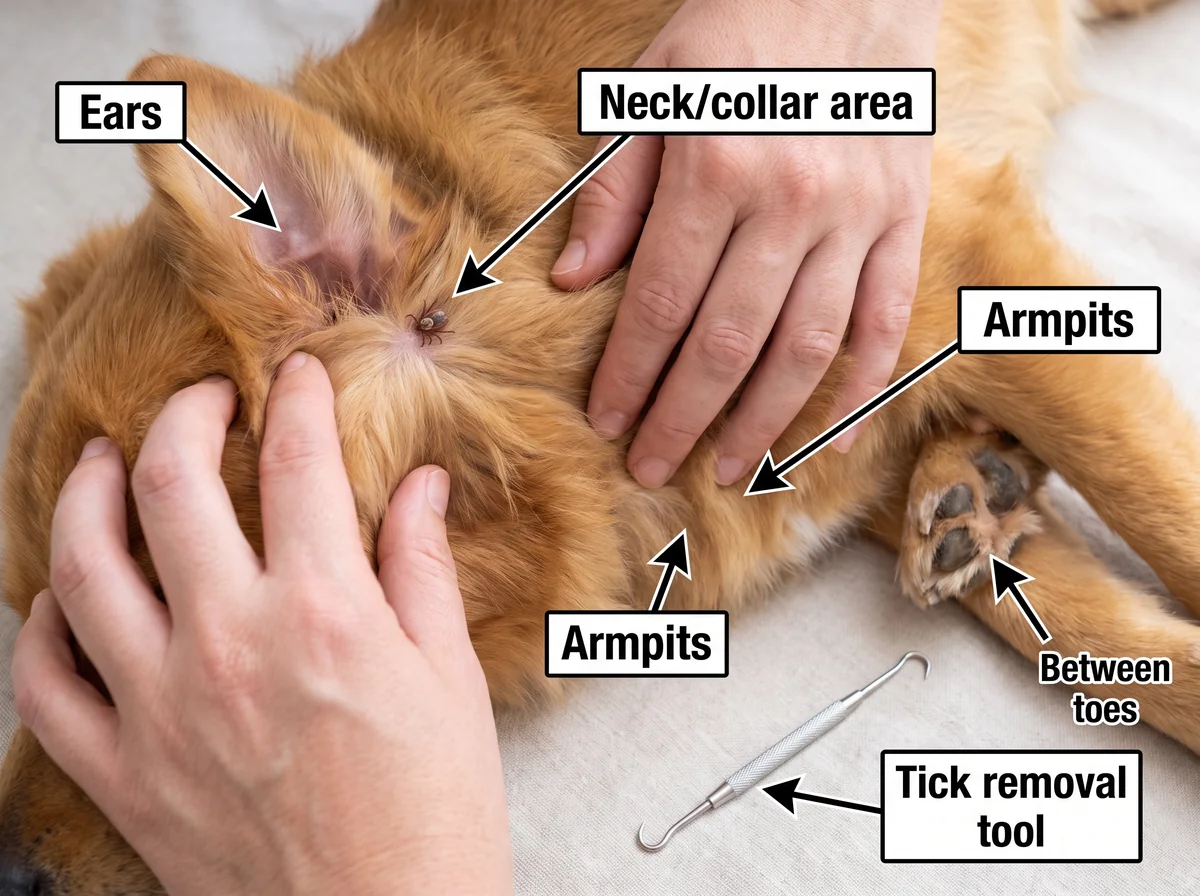
Begin your search around your dog's head and neck where ticks commonly attach. Use your fingertips like a gentle comb, pressing lightly through the coat until you reach the skin level. Move your hands across the muzzle, beneath the chin, and along the collar area. Dogs explore brush headfirst, which makes the face and neck prime landing spots for questing ticks.
Check inside and behind both ears thoroughly during this initial step. Feel along the outer ear flaps, around the base of each ear, and inside the folds where fur is thinner. Ticks often crawl into these warm, concealed crevices where they can feed undisturbed. Part the hair carefully if your fingers catch on any unusual raised bump or scab-like texture.
Move down along the chest, shoulders, and front legs to complete the upper-body check. Slide your fingers between the front legs and into the armpit folds where the skin remains warm and protected. Examine the pads of the front paws and spread each individual toe to inspect the webbing, where immature ticks can easily hide from view without notice.
- Check around the collar line, muzzle, and underneath the chin.
- Feel along the inner and outer folds of both ear flaps.
- Spread front toes to examine the thin skin between foot pads.
For another part of the identification, open Removing a Tick from a Dog: What Should You Know?.
What Does an Attached Tick Feel Like Under Fur?
An attached tick feels like a small, firm bump anchored directly to your dog's skin. Unlike loose dirt, a seed, or plant debris, you cannot brush an attached tick away with a simple stroke of your hand. When you press your fingertip against the spot, it will feel stationary and firmly attached by its mouthparts beneath the fur line.
The size and texture of the bump vary depending on how long the tick has been feeding. An unfed tick feels flat, hard, and tiny, sometimes no larger than a pinhead or small seed. As an adult female feeds on a blood meal, her body swells and softens, eventually feeling like a smooth, rounded, bean-shaped mass under your fingers.
Distinguishing a tick from a normal skin tag or mole requires parting the fur under bright light. A natural skin growth matches your dog's skin tone and lacks visible appendages or markings. In contrast, an attached tick reveals distinct dark legs near the attachment point and a specialized shield or pattern on its back when viewed closely.
- Feels like a firm, unmovable bump attached directly to the skin surface.
- Unfed ticks feel small and flat, while engorged ticks feel round and swollen.
- A parted coat reveals legs and a distinct body structure rather than plain skin.
A related clue is covered in Dog Tick Bite Identification: What Does It Look Like?.
If you want a second reference, BugKnow’s dog tick page covers the same topic from another angle.
How Do You Check the Lower Body and Hidden Crevices?
Continue your physical inspection by moving your hands down your dog's back, flanks, and ribcage. Run your fingers against the direction of hair growth so your skin makes direct contact with the coat base. Ticks may attach along the spine or sides, though they frequently crawl downward toward sheltered spots with thinner skin and less thick hair.
Roll your dog gently onto their side or back to inspect the belly and groin area. Feel around the inner thighs, lower abdomen, and surrounding skin folds where hair is sparse. These protected locations offer ideal attachment sites for ticks seeking quiet spots. Scan the area visually while feeling with your fingertips to catch any flat, dark specks on pale skin.
Finish the routine by checking around the hindquarters, beneath the tail, and between the rear toes. Lift the tail to examine the base and the surrounding sensitive skin. Run your fingers down both back legs, feeling the hocks and checking between every rear claw. Immature stages like tiny larvae and nymphs frequently settle in these low, overlooked sections.
- Feel against the grain of the fur along the back and ribcage.
- Inspect the groin, inner thighs, and lower belly where fur is thin.
- Examine under the base of the tail and between rear paw pads.
For another part of the identification, open Dog Tick Prevention: How Can You Avoid It?.
What Markings Can Help You Identify the Tick?
Once you locate an attached parasite, inspect its visible markings to identify the species and life stage. Adult female American dog ticks display a light cream or off-white scutum shield over the front third of their dark brown body. Adult males have a scutum covering their entire back with a mottled pattern of cream and gray markings throughout.
Examine the rear edge of the body to look for festoons, which are small rectangular grooves or notches. Both male and female American dog ticks feature these distinct scalloped segments along their rear margins. In contrast, brown dog ticks are uniformly reddish-brown without contrasting cream patterns, though males also carry a full-length scutum shield over their backs.
Note the overall body shape, coloration, and leg count under a magnifying glass or bright flashlight. Adult ticks and nymphs have eight legs, whereas tiny six-legged larvae indicate an early life stage. If you notice a swollen, gray or dark pinto bean shape, you are looking at an engorged adult female that has taken a substantial blood meal.
- American dog ticks show cream or off-white patterns against reddish-brown bodies.
- Brown dog ticks have uniform reddish-brown coloring without pale back markings.
- Look for tiny segmented notches called festoons along the rear abdomen edge.
This also connects with Dog Tick Habitat: Where Does It Live?.
Could Multiple Ticks Point to a Single Infestation?
Finding several ticks of different sizes on your dog does not necessarily mean your pet encountered multiple wild species. In many domestic situations, discovering various sizes reflects different active life stages of the brown dog tick. This species can complete its entire life cycle indoors, leading to simultaneous activity from larvae, nymphs, and adults on one animal.
Larval ticks are tiny, pinhead-sized parasites with six legs that can easily go unnoticed in heavy fur. As they feed and molt into eight-legged nymphs, they reach roughly poppy-seed size before developing into full reddish-brown adults. Because all these stages require blood meals, an infested sleeping area or yard can deposit multiple generations on your dog at once.
Carefully check your dog's bedding, crate, and resting areas if you discover multiple ticks during your physical inspection. Brown dog ticks are uniquely capable of surviving and multiplying inside structural environments like homes and kennels. Identifying whether you face outdoor wanderers or an established indoor population helps you choose the right management approach for your household.
- Different sizes on one pet often represent varied life stages of one species.
- Six-legged larvae and eight-legged nymphs are much smaller than adults.
- Brown dog ticks can reproduce indoors, infesting dog bedding and kennel areas.
You can check the same detail against Dog Tick Diseases: What Should You Know?.
Related identification guides
Dog Tick Bite Identification: What Does It Look Like?
identify a fresh or healing dog tick bite mark on skin
habitatDog Tick Habitat: Where Does It Live?
understand where dog ticks live outdoors and how dogs pick them up
preventionDog Tick Prevention: How Can You Avoid It?
find general, safe ways to prevent ticks on dogs
signsRemoving a Tick from a Dog: What Should You Know?
find safe general guidance for removing an attached tick from a dog
Frequently asked questions
How often should you check your dog for ticks?
Perform a thorough tick check daily if your dog spends time outdoors in grassy fields, brushy borders, or wooded paths. A quick manual check every time your dog comes inside from tall vegetation allows you to locate wandering ticks before they attach. Because removing an attached tick promptly reduces the risk of disease transmission, consistent daily inspections offer the most dependable protection.
What is the best technique for feeling ticks through thick dog fur?
Use the pads of your fingers to press gently through the topcoat until you make contact with the skin surface. Move your hands slowly in small circular motions against the natural grain of the fur. When your fingertips catch on any raised, stationary bump, use both hands to part the coat widely under direct lighting to verify whether the object is a tick.
Can you miss immature ticks during a standard coat check?
Immature ticks such as larvae and nymphs are extremely small and easy to overlook in dense fur. Larvae are roughly the size of a pinhead, while nymphs resemble tiny poppy seeds. To catch these small stages, focus closely on areas with thin hair, such as the ear edges, belly, groin, and between the toes, using good light and careful fingertip palpation.
What should you do immediately after finding an attached tick on your dog?
Remove the attached tick promptly to minimize disease transmission risks. Grasp the tick close to the skin surface using fine-tipped tweezers and pull upward with steady, even pressure without twisting. Avoid squeezing the swollen body. After removal, clean the bite area on your dog's skin with soap and water or an antiseptic, and wash your hands thoroughly.