Quick identification facts
Immature Dog Tick Inspection Checklist
Use these observable physical markers to check whether a tiny speck found on your pet or clothing is a larval or nymphal dog tick.
What Does a Larval Dog Tick Look Like?
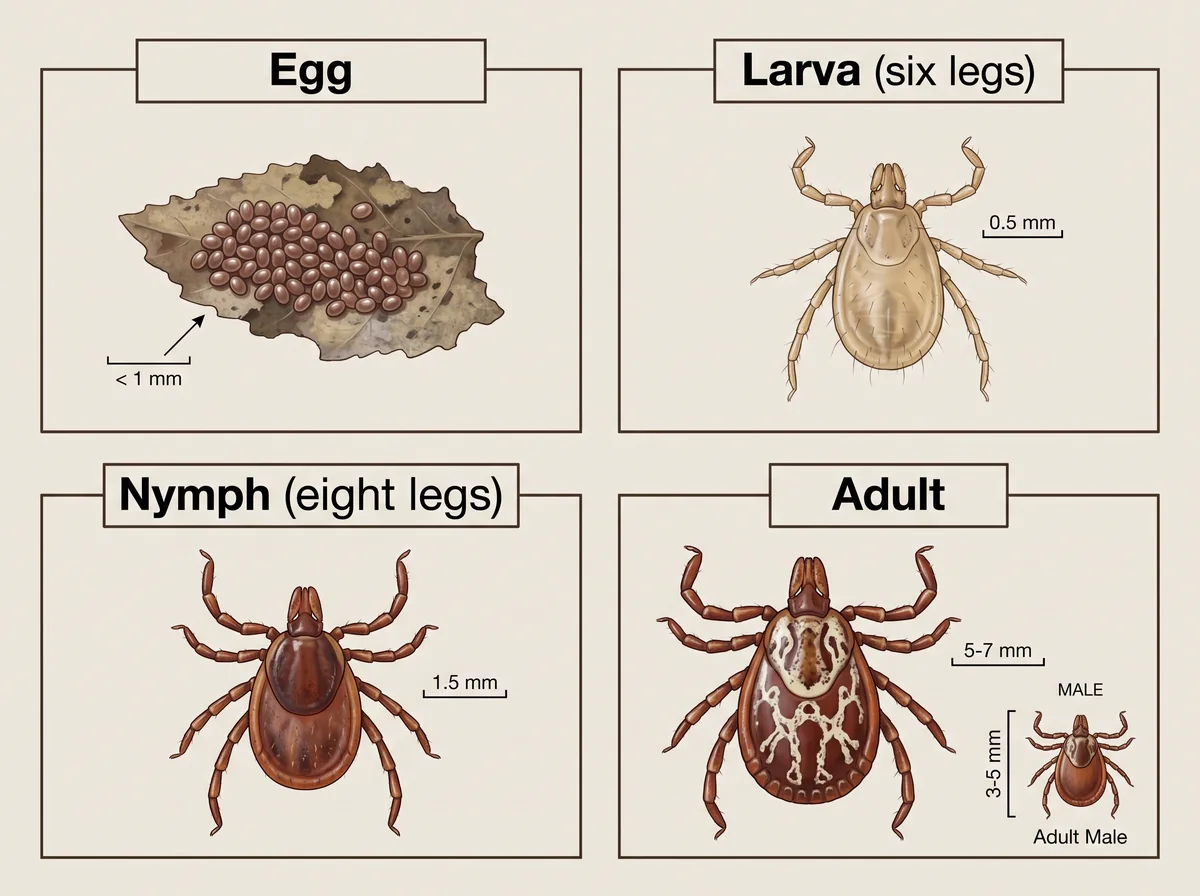
A larval dog tick is the smallest mobile stage that hatches from an egg batch. When you look closely, you will see a creature measuring roughly 0.60 millimeters long and 0.40 millimeters wide. It is roughly the size of a standard pinhead. At this point, the larva is light tan to dark brown and completely lacks the ornate markings found on mature ticks.
The easiest way to tell a larva apart from older ticks is by counting its legs. Larvae emerge from their eggs with only six legs instead of the normal eight found on mature arachnids. Because of this trait, you might easily mistake a larva for a small beetle, clover mite, or flea when inspecting your dog's skin after a walk outdoors.
These tiny larvae hatch in leaf litter or ground debris where females deposit eggs. They usually hatch during the warm months and overwinter before searching for their first host in spring. Because of their microscopic profile, you will rarely spot a single unfed larva unless dozens of them cluster together on a blade of grass or brush against your skin.
- Pinhead body dimensions near 0.60 mm by 0.40 mm
- Six active walking legs instead of eight
- Uniform tan to brown coloring without scutum patterns
For the next useful comparison, see Dog Tick Eggs: What Does It Look Like?.
How Can You Spot a Dog Tick Nymph?
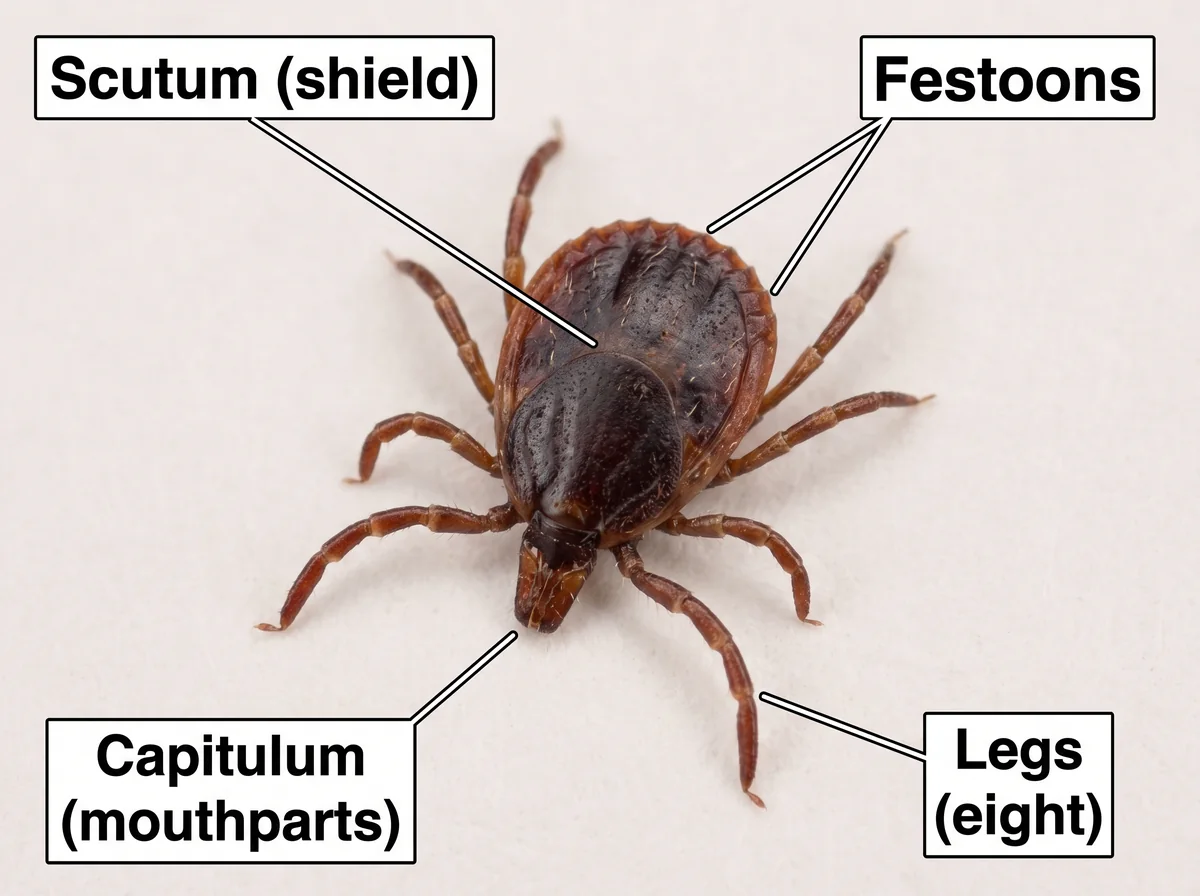
After a larva takes its first blood meal and drops off its host, it molts into a nymph. The nymphal dog tick is roughly twice the size of a larva, measuring approximately 0.90 millimeters long and 0.80 millimeters wide. This puts it at roughly the size of a poppy seed, which is still remarkably small compared to an adult tick.
During this transition, the nymph gains its fourth pair of legs, giving it the full eight-legged structure typical of ticks. Its body remains a plain reddish-brown to dark brown hue. You will not see the distinct cream or off-white mottled shield that helps identify an adult American dog tick, which can make field identification tricky without magnification.
Nymphs are active crawlers that quest on low vegetation to grab passing animals. When you part your dog's fur, a nymph appears as a dark freckle or tiny scab firmly attached to the skin. Because their mouthparts are small, their bites rarely cause instant irritation, allowing them to feed unnoticed for days if you do not perform a careful hands-on check.
- Poppy-seed dimensions measuring about 0.90 mm by 0.80 mm
- Eight fully formed walking legs
- Solid reddish-brown tone without white or cream shield patterns
This also connects with Dog Tick Life Cycle: How Does It Develop?.
If you want a second reference, BugKnow’s dog tick appearance page covers the same topic from another angle.
Why Are Immature Ticks So Difficult to Find?
The primary challenge with immature dog ticks is their minuscule physical footprint. While an unfed adult dog tick measures roughly one-quarter inch long, larvae and nymphs are mere fractions of that size. When hidden under thick fur or along the dark skin folds of your pet, these young stages blend seamlessly into the background.
Their feeding habits also make them easy to overlook in daily life. American dog ticks use a three-host life cycle where larvae and nymphs frequently feed on small wild mammals like rodents rather than dogs. However, brown dog tick immatures will readily feed on domestic dogs at every stage, often tucking themselves deep inside your pet's ears or between paw pads.
An unfed immature tick is flat and paper-thin, allowing it to slide beneath animal hair without creating an obvious bump. As it feeds, its abdomen expands, but even an engorged nymph remains smaller than an unfed adult. You need bright direct light and a fine-tooth comb to reveal these tiny pests before they finish feeding and detach.
- Flat, ultra-thin profiles that sit flush against your pet's skin
- Preference for hidden spots such as deep ear canals and between toes
- Significantly smaller body volume compared to quarter-inch adult ticks
For the next useful comparison, see Dog Tick Size: How Big Is It?.
How Does the Three-Host Life Cycle Work?
Both the American dog tick and brown dog tick require blood meals to advance through their developmental stages. The cycle starts when a female deposits thousands of eggs in surface debris or indoor cracks. Once hatched, the six-legged larva must find a host, feed to repletion, and drop to the ground to molt into an eight-legged nymph.
The nymph repeats this process by locating a second host animal, consuming another full blood meal, and dropping off to transform into an adult. The full life cycle from egg to mature adult typically takes around two years in natural conditions, though it can range from a few months to three years depending on local temperature and moisture.
Immature ticks possess impressive survival stamina while waiting for suitable hosts. Unfed ticks can endure extended periods without food, surviving seasonal freezes under leaf litter. When you understand this cycle, you can see why clearing outdoor ground cover and inspecting your pets regularly disrupts their progression before they reach maturity and reproduce.
- Four total stages consisting of egg, larva, nymph, and adult
- Mandatory blood meal required before every single molt
- Typical development window of roughly two years in outdoor environments
This also connects with Dog Tick Bite Identification: What Does It Look Like?.
Where Should You Search on Your Dog?
Because larvae and nymphs are exceptionally tiny, you should focus your physical search on areas with thin skin and rich blood flow. Check closely around your dog's eyelids, muzzle, base of the ears, and inner ear flaps. Immature ticks frequently crawl toward the head and neck where the animal cannot easily scratch or groom them off.
Next, run your fingers slowly down your pet's legs and feel between each individual toe. Larvae and nymphs often latch onto the soft webbing between paw pads after your dog walks through brush or resting areas. Pay equal attention to the armpits, groin, belly, and underneath the collar where warmth and shelter keep them protected.
Use your fingertips rather than just your eyes, feeling for tiny, unexpected bumps resembling raised sand grains or small scabs. If your fingers catch on a speck, part the fur completely under a bright flashlight. If you find a tiny six-legged or eight-legged parasite attached, use fine-tipped tweezers to pull it straight out without twisting.
- Ears, muzzle, eyelids, and under collar bands
- Webbing between toe pads and underneath the paws
- Warm, sheltered zones around the armpits and groin
For another part of the identification, open How to Check Your Dog for Ticks?.
Related identification guides
Dog Tick Size: How Big Is It?
find exact size measurements for dog ticks unfed and engorged, at every life stage
life cycleDog Tick Life Cycle: How Does It Develop?
understand the egg-larva-nymph-adult stages and how long the cycle takes
eggsDog Tick Eggs: What Does It Look Like?
identify tick eggs and understand whether ticks lay eggs directly on a dog
signsDog Tick Bite Identification: What Does It Look Like?
identify a fresh or healing dog tick bite mark on skin
Frequently asked questions
Can baby dog ticks bite humans as well as pets?
Yes, immature dog ticks can bite humans, although adult American dog ticks are far more commonly encountered on people. Brown dog tick larvae and nymphs will readily feed on both humans and dogs if present in living spaces. Because baby ticks are the size of a pinhead or poppy seed, you might not feel the bite at all, making daily visual body checks necessary after spending time in brushy yards or infested structures.
How do you tell a tick larva from a tick nymph?
The most definitive way to distinguish a tick larva from a tick nymph is by counting the walking legs under magnification. A larva always possesses six legs and measures roughly the size of a pinhead (0.60 mm). A nymph has molted into the arachnid form with eight legs and measures about twice as large (0.90 mm), resembling a dark poppy seed. Both stages lack the mottled white patterns found on adult dog ticks.
Do baby dog ticks look like small deer ticks?
Baby dog ticks can easily be confused with deer ticks because of their tiny size. Dog ticks are generally about double the size of deer ticks at matching stages, but an unfed dog tick nymph is very close in dimensions to an adult deer tick, which is roughly the size of a sesame seed. Without a magnifying lens to check scutum patterns and mouthpart shapes, telling immature stages apart by eye is difficult.
What should you do if you find a cluster of tick larvae?
If you encounter a dense cluster of tick larvae outdoors or on your pet, remove them immediately to prevent widespread attachment. On your pet, use sticky tape or a fine comb dipped in soapy water for loose larvae, or fine-tipped tweezers for attached ones. Wash the bite area with soap and water. Finding hundreds of tiny larvae in one spot usually indicates an egg mass recently hatched nearby in the yard or bedding.