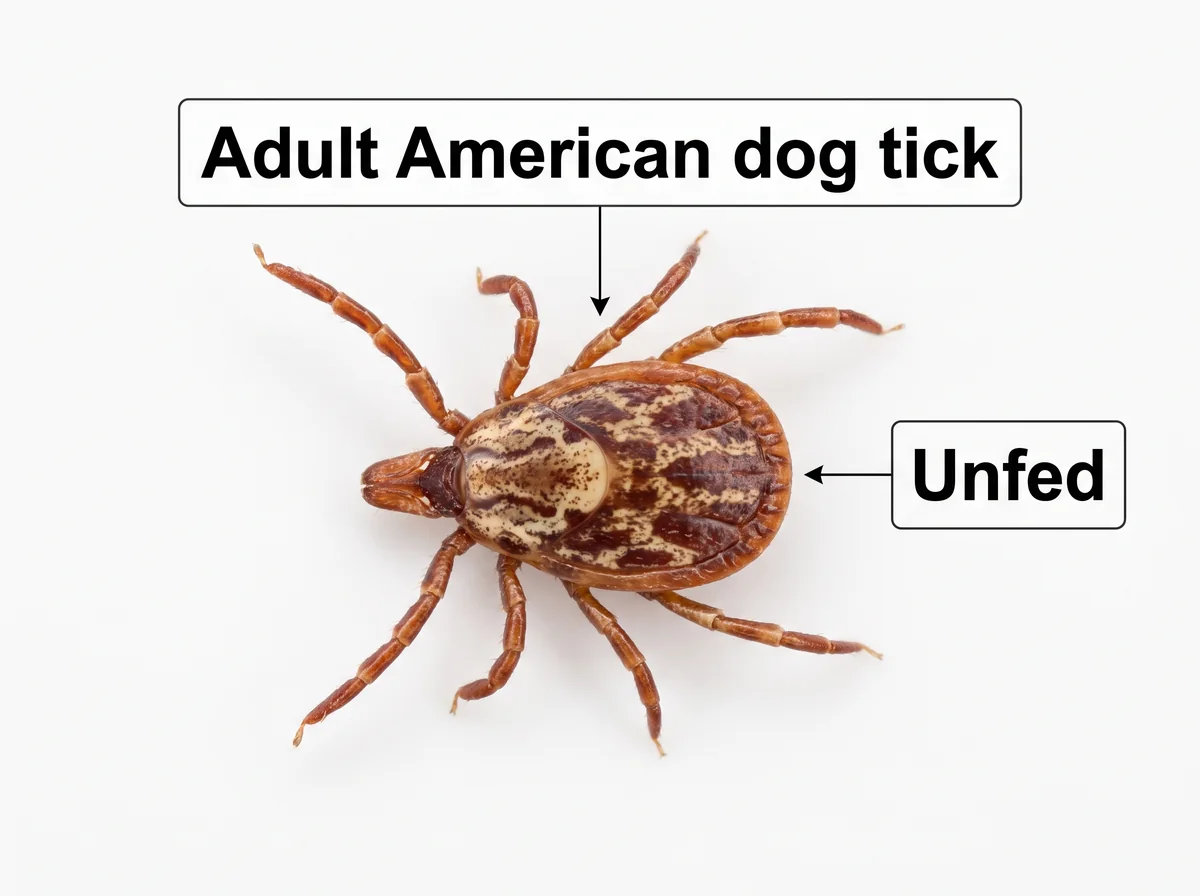
Quick identification facts
Tick vs. Skin Tag Quick Checker
Examine the bump on your dog under bright light and check the visible characteristics below to distinguish an attached tick from a benign skin tag.
How Can You Spot the Difference at the Base?
When you part your dog's fur to examine a bump, look directly where the object connects to the skin. An attached tick has its mouthparts embedded into the tissue, but its main body remains separate. You can often see tiny legs clustered near the base of an unfed or partially fed tick. A natural skin tag connects seamlessly as continuous flesh without any separate insect mouthparts.
A tick's body is firm, oval, or swollen, depending on how long it has fed on your pet. Adult ticks and nymphs possess eight jointed legs, while tiny larvae have six legs. If you gently push the growth aside with clean tweezers, you can observe whether tiny legs project from the underside. A skin tag is soft, fleshy, and moves as an unbroken extension of the dog's outer skin layer.
Color provides another direct clue when examining the connection point on your dog. A skin tag typically matches your dog's skin tone or appears slightly pigmented, pink, or grayish. In contrast, an American dog tick has a reddish-brown body with distinct cream or off-white markings on its scutum. Brown dog ticks are uniformly reddish-brown without any mottled patterns across their backs.
- Look for tiny jointed legs near the skin surface to confirm a tick.
- Check if the growth is an attached parasite or continuous dog skin.
- Observe whether the color shows natural skin pigmentation or tick markings.
For the next useful comparison, see Engorged Dog Tick: What Should You Know?.
What Does an Engorged Dog Tick Look Like?
A fully engorged female American dog tick changes shape dramatically as it takes a blood meal, swelling until it resembles a dark pinto bean. This substantial expansion can make the tick look like a smooth, round skin growth at first glance. However, the tick's hard dorsal shield remains visible as a small plate right behind the embedded mouthparts, while the abdomen stretches outward.
On female American dog ticks, the cream or off-white scutum covers only about the front third of the body. As the tick feeds, this pale shield stays small while the rest of the dark body expands behind it. On male American dog ticks, the mottled scutum covers the entire dorsal surface, so males do not swell into large bean-shaped bodies. A skin tag never develops a hard protective shield.
The rear margin of an unfed or moderately fed American dog tick also shows distinct segmented notches known as festoons. While severe engorgement can stretch the outer skin and smooth out these festoons, you can still spot the hard scutum near the front. Skin tags lack any symmetrical ridges, segmental plates, or dorsal shield markings, remaining irregular and uniformly soft throughout.
- Fully fed female American dog ticks swell into smooth, bean-like shapes.
- The hard scutum remains visible behind the head even when the body expands.
- Segmented rear notches called festoons appear on American dog ticks.
If you want a second reference, BugKnow’s dog tick page covers the same topic from another angle.
Where Should You Check Your Dog Most Thoroughly?
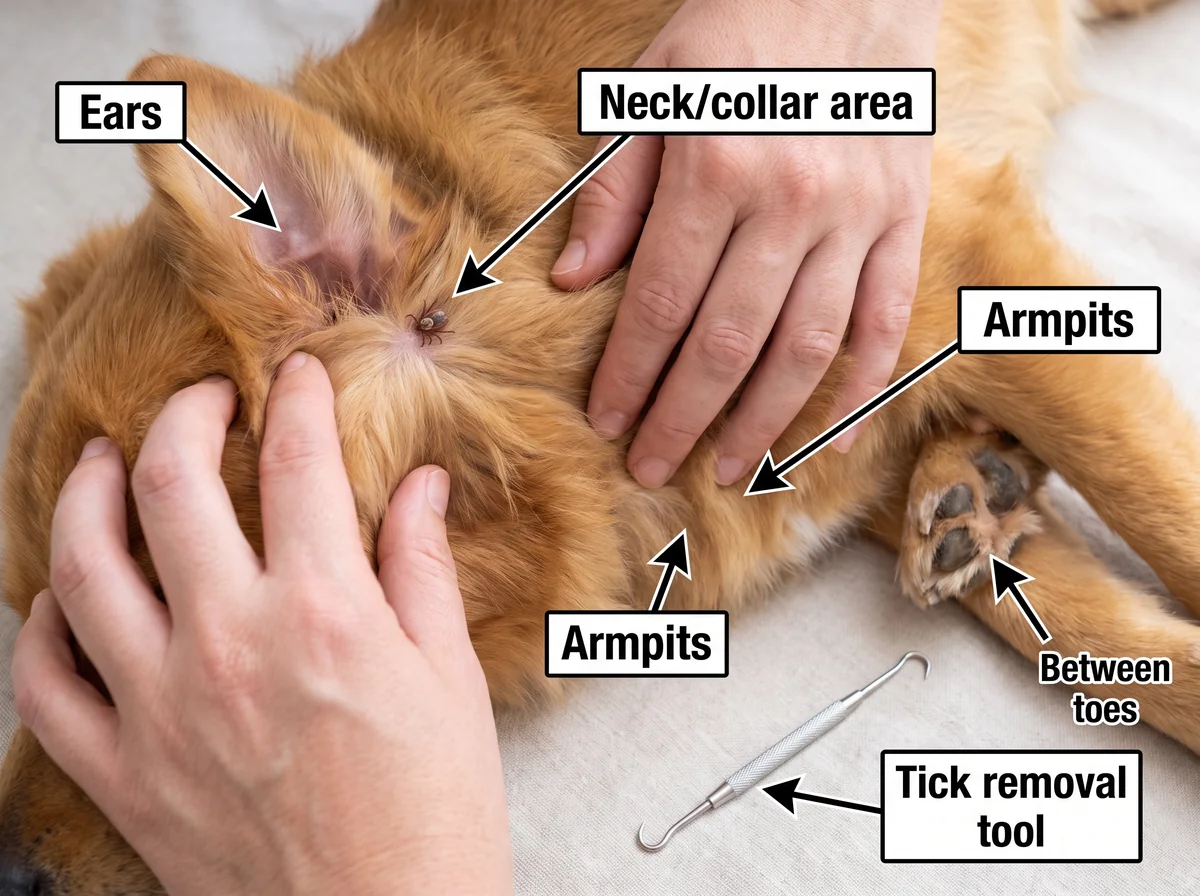
A thorough tick check should include areas where ticks commonly attach to a dog, as these pests prefer warm, sheltered spots on the body. Carefully inspect inside and behind your dog's ears, under the collar, between the toes, and around the groin. Skin tags can appear anywhere on older dogs, but ticks actively seek out thin-skinned areas where they can feed undisturbed.
Immature life stages, such as larvae and nymphs, are exceptionally small and easily missed during a casual petting session. Larval ticks have six legs and measure only a fraction of an inch, while nymphs have eight legs. Because these tiny stages can hide beneath thick fur, running your fingers slowly across the skin allows you to feel small bumps that need closer visual inspection with a flashlight.
If you discover several bumps indoors or on your pet, keep in mind that multiple ticks found on a dog are frequently different life stages of the same brown dog tick infestation. Brown dog ticks can complete their entire life cycle indoors in homes and kennels. Inspecting your dog regularly helps you catch both tiny nymphs and larger adult ticks before they feed for extended periods.
- Focus your inspection on ears, neck folds, paw pads, and groin areas.
- Feel beneath thick fur for small bumps representing tiny larvae or nymphs.
- Examine multiple bumps closely to check for different life stages of ticks.
For another part of the identification, open Dog Tick Bite Identification: What Does It Look Like?.
How Do American and Brown Dog Ticks Differ?
Telling different dog tick species apart helps you recognize what you are seeing on your dog's coat. Adult American dog ticks feature a dark reddish-brown base color highlighted by white or cream-colored markings. Female American dog ticks have a light scutum over the front third of their body, while males display a mottled cream-and-gray pattern that extends over their entire back.
Brown dog ticks present a distinctly different appearance because they are uniformly reddish-brown with no decorative mottled markings. On male brown dog ticks, the uniform scutum covers the whole dorsal surface, whereas on females it covers only the area directly behind the mouthparts. Both species have eight legs in their adult and nymphal stages, distinguishing them immediately from natural skin tags.
Size and pattern variations can make unfed ticks look quite different from attached, feeding ticks on your pet. Unfed dog ticks are flat and oval, allowing their legs and scutum patterns to remain clearly visible. If you spot a smooth, unmarked reddish-brown bump with legs at the base, you are likely looking at a brown dog tick rather than an American dog tick or a skin tag.
- American dog ticks have distinct white or cream markings on their backs.
- Brown dog ticks are solid reddish-brown without decorative dorsal patterns.
- Both tick species possess eight legs as adults, unlike harmless skin tags.
Why Is Prompt Identification Important for Dog Owners?
Accurately identifying a bump on your dog ensures you take the right action without causing unnecessary irritation. Removing an attached tick promptly reduces the risk of disease transmission, as ticks generally require a period of attachment to transmit pathogens. If you mistake a tick for a skin tag and leave it attached, the parasite continues feeding and swelling over several days.
Attempting to pull or cut a skin tag off your dog causes pain, bleeding, and potential infection, which is why close inspection is essential before taking action. If the bump has no legs, lacks a hard scutum, and connects smoothly to surrounding tissue, it is likely a benign growth that requires veterinary evaluation rather than home removal with tweezers.
When you confirm that a bump is indeed an attached tick, use fine-tipped tweezers to grasp the tick close to your dog's skin and pull straight upward with steady pressure. Avoid twisting or jerking, which can leave mouthparts behind. Identifying whether the removed parasite is an American dog tick, brown dog tick, or another look-alike helps you monitor your pet effectively afterward.
- Prompt removal of an attached tick reduces disease transmission risks.
- Never attempt to twist or cut a bump that lacks clear tick characteristics.
- Use fine-tipped tweezers for steady removal once a tick is confirmed.
For the next useful comparison, see How to Check Your Dog for Ticks?.
Related identification guides
American Dog Tick Identification: What Does It Look Like?
identify the American dog tick specifically by color, shield pattern, and size
appearanceEngorged Dog Tick: What Should You Know?
identify a full, blood-fed tick found on a dog
signsDog Tick Bite Identification: What Does It Look Like?
identify a fresh or healing dog tick bite mark on skin
signsHow to Check Your Dog for Ticks?
learn a practical method for inspecting a dog's body for ticks
Frequently asked questions
Can a skin tag on a dog have legs?
No, a skin tag will never have legs. Skin tags are benign outgrowths composed entirely of your dog's skin cells and connective tissue. If you look closely with a magnifying glass and see six or eight tiny jointed legs near the skin surface, the bump is an attached tick rather than a skin tag.
Why does an engorged tick feel like a smooth skin bump?
As a female tick consumes blood, its soft abdomen expands significantly, smoothing out the body until it resembles a round bean or fleshy growth. Even though it feels smooth and plump to the touch, you can still find the small, hard scutum plate and tiny legs clustered right where it meets your dog's skin.
What colors are common for dog ticks compared to skin tags?
Skin tags typically match your dog's skin tone, appearing pink, gray, or black. American dog ticks are reddish-brown with cream or off-white markings on their back, while brown dog ticks are solid reddish-brown. Fully engorged ticks often turn a slate-gray, olive, or dark bean-like shade as they fill with host blood.
What should you do if you are unsure whether a bump is a tick?
If you cannot clearly see legs or a distinct scutum, do not pull forcefully on the bump. Pulling a natural skin tag, wart, or cyst will hurt your dog and cause bleeding. Part the fur under bright light, take a clear photo to examine closely, or have your veterinarian inspect the growth safely.