Quick identification facts
Dog Tick Bite Assessment Checklist
Review these visible skin signs to determine whether your bite mark reflects a standard healing reaction or requires professional medical evaluation.
What Does a Fresh Bite Mark Look Like?
When you first remove a dog tick, you will usually see a compact red spot directly where the mouthparts pierced the skin. This mark is often slightly elevated, firm to the touch, and surrounded by a faint ring of pink irritation. Mild itching or tenderness is a standard inflammatory response to tick saliva.
On dogs, you might discover the bite as a small crusty scab or a raised pimple-like welt under the fur. Because dog ticks are slow feeders that stay attached for days if undisturbed, the surrounding tissue may feel warm or slightly hardened. The mark typically remains smaller than a dime in diameter.
Your skin should begin settling down within a few days after you detach the parasite. A typical localized reaction will not spread across the limb or produce severe swelling. If the redness remains confined strictly to the original puncture point, it generally reflects mechanical trauma rather than a systemic tick-borne infection.
- Small, firm red welt at the exact puncture point
- Mild localized itching or tender swelling
- Tiny scab forming within forty-eight hours of removal
You can check the same detail against Dog Tick Diseases: What Should You Know?.
How Does a Healing Bite Progress Over Time?
A normal healing bite gradually fades from bright red to a dull pink or light brown over one to two weeks. As your body repairs the puncture, a tiny dry scab often forms over the center. You should notice the initial swelling and itching subside steadily during this period.
On your dog, the firm nodule beneath the coat can sometimes linger for several weeks even after the surface wound closes. This small granuloma is simply a harmless immune reaction to tick mouthpart proteins left in the dermis. As long as the bump shrinks and shows no discharge, healing is progressing normally.
You can monitor the site by checking for changes in color, size, and texture every day. If the wound stays dry, stops itching, and gradually flattens out, your body is resolving the bite cleanly. Any sudden reversal in healing, such as renewed heat or spreading color, requires closer observation.
- Redness fades to light pink over seven to fourteen days
- Surface scab falls off naturally without oozing
- Firm skin bump under animal fur slowly shrinks
This also connects with How to Check Your Dog for Ticks?.
To compare this detail with another source, Insectio’s dog tick appearance page offers a useful cross-check.
Which Warning Signs Point to a Disease Reaction?
A disease reaction differs sharply from simple localized skin irritation. While normal bites stay small, infections like Rocky Mountain spotted fever can cause distinct full-body symptoms or a rash spreading outward from wrists, ankles, or the bite site. Untreated Rocky Mountain spotted fever has a mortality rate of over 20%.
You should watch for high fever, deep muscle aches, severe headaches, or chills developing within two weeks of a bite. On your pets, look for sudden lethargy, loss of appetite, pale gums, or joint stiffness. Brown dog ticks can transmit dangerous canine blood parasites like Ehrlichia canis and Babesia canis.
Another critical sign in pets is canine tick paralysis, a rare motor condition caused by neurotoxins in American dog tick saliva. If you notice your dog developing weakness in the hind legs or an unsteady gait, prompt veterinary care is necessary. Unlike deer tick bites, dog tick bites do not produce Lyme disease.
- Expanding rash, spotted lesions, or petechiae
- Systemic fever, severe headache, and muscle pain
- Lethargy, joint stiffness, or hind-leg weakness in dogs
A related clue is covered in Tick or Skin Tag on Dog: What Should You Know?.
Where Should You Search for Attached Ticks?
Finding the feeding tick itself is often how you identify a bite before the mark even forms. Immature life stages like pinhead-sized larvae and poppy-seed-sized nymphs attach in secluded spots and are very easy to miss. A thorough daily body scan helps you catch them before prolonged attachment occurs.
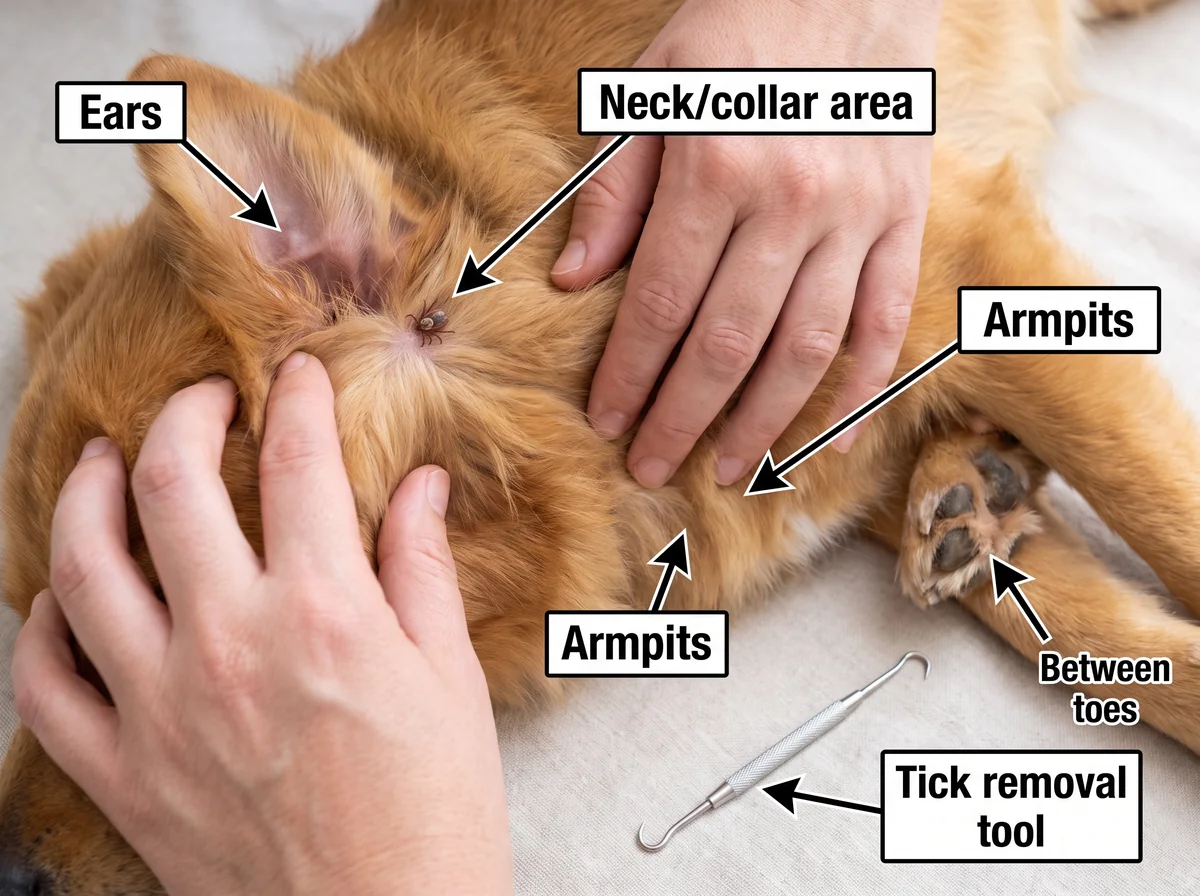
When checking your dog, focus your hands and eyes on hidden warm areas where ticks prefer to feed. Carefully inspect deep inside and behind the ears, between the paw pads and toes, under the collar, around the groin, and beneath the tail. Feeling through thick fur with your fingertips often reveals feeding ticks faster than looking.
If you discover multiple ticks on your dog or wandering across indoor furniture, you may be dealing with a brown dog tick infestation. Unlike most outdoor species, the brown dog tick can complete its entire life cycle indoors. Multiple specimens found in living quarters frequently represent different developmental stages of this single species.
- Inside and around the ear flaps and neck folds
- Between the toes, paw pads, and armpits
- Along the groin, belly, and base of the tail
For another part of the identification, open Dog Tick Habitat: Where Does It Live?.
How Does Tick Appearance Help You Assess Risk?
Identifying the physical features of the tick you removed helps you evaluate the specific pathogen risks involved. Adult American dog ticks are reddish-brown with segmented notches called festoons along the rear rim. Adult females have a distinct off-white scutum covering the front third of their back, while males display mottled cream markings over their entire bodies.
In contrast, brown dog ticks are uniformly reddish-brown without decorative cream patterns. A fully engorged female American dog tick swells up to the size and shape of a dark pinto bean after feeding on blood. Unfed nymphs and adults have eight walking legs, whereas tiny newly hatched larvae possess only six legs.
Because dog ticks are generally slow feeders, disease transmission takes hours of continuous attachment rather than happening immediately. Removing an attached tick promptly reduces the risk of disease transmission significantly. Save the detached tick in a sealed container so you can photograph or present it to a professional if symptoms arise.
- American dog tick: mottled cream scutum markings and rear festoons
- Brown dog tick: plain reddish-brown body without pale markings
- Engorged female: swollen, rounded body resembling a pinto bean
You can check the same detail against Dog Tick Prevention: How Can You Avoid It?.
Related identification guides
How to Check Your Dog for Ticks?
learn a practical method for inspecting a dog's body for ticks
habitatDog Tick Habitat: Where Does It Live?
understand where dog ticks live outdoors and how dogs pick them up
harmDog Tick Diseases: What Should You Know?
learn what diseases dog ticks can transmit and how serious they are
faqTick or Skin Tag on Dog: What Should You Know?
figure out whether a bump on a dog's skin is an attached tick or something else like a skin tag
Frequently asked questions
Can a dog tick bite give you Lyme disease?
No, dog tick bites do not transmit Lyme disease. That bacterial infection is spread exclusively by blacklegged (deer) ticks. However, American dog ticks are primary vectors for Rocky Mountain spotted fever and tularemia, while brown dog ticks can transmit Rocky Mountain spotted fever in the southwestern United States and canine blood disorders to pets. You should monitor for distinct fever and rash symptoms after any bite.
Why is there still a hard lump after removing a dog tick?
A small, firm bump under your skin or your dog's fur is a common inflammatory reaction to the tick's saliva and mechanical feeding damage. This localized granuloma can persist for several weeks after the tick is gone while the immune system clears the area. As long as the bump gradually shrinks, remains painless, and does not show spreading redness or fluid discharge, it is normally harmless.
How quickly do dog ticks transmit diseases after biting?
Dog ticks are slow feeders, and disease transmission from an attached tick typically takes hours of attachment rather than occurring instantaneously. Because bacterial pathogens require time to activate and pass through salivary glands, checking your body and pets daily allows you to locate and remove attached ticks early. Prompt removal drastically reduces the likelihood of contracting Rocky Mountain spotted fever, tularemia, or canine blood parasites.
What does an infected dog tick bite look like on a dog?
An infected bite on a dog may become hot to the touch, severely swollen, inflamed, or discharge pus due to secondary bacterial contamination. If the tick transmitted a systemic pathogen like Ehrlichia canis, Babesia canis, or Rocky Mountain spotted fever, your dog will often develop whole-body symptoms such as lethargy, sudden fever, lameness, and loss of appetite rather than just a dramatic skin mark.