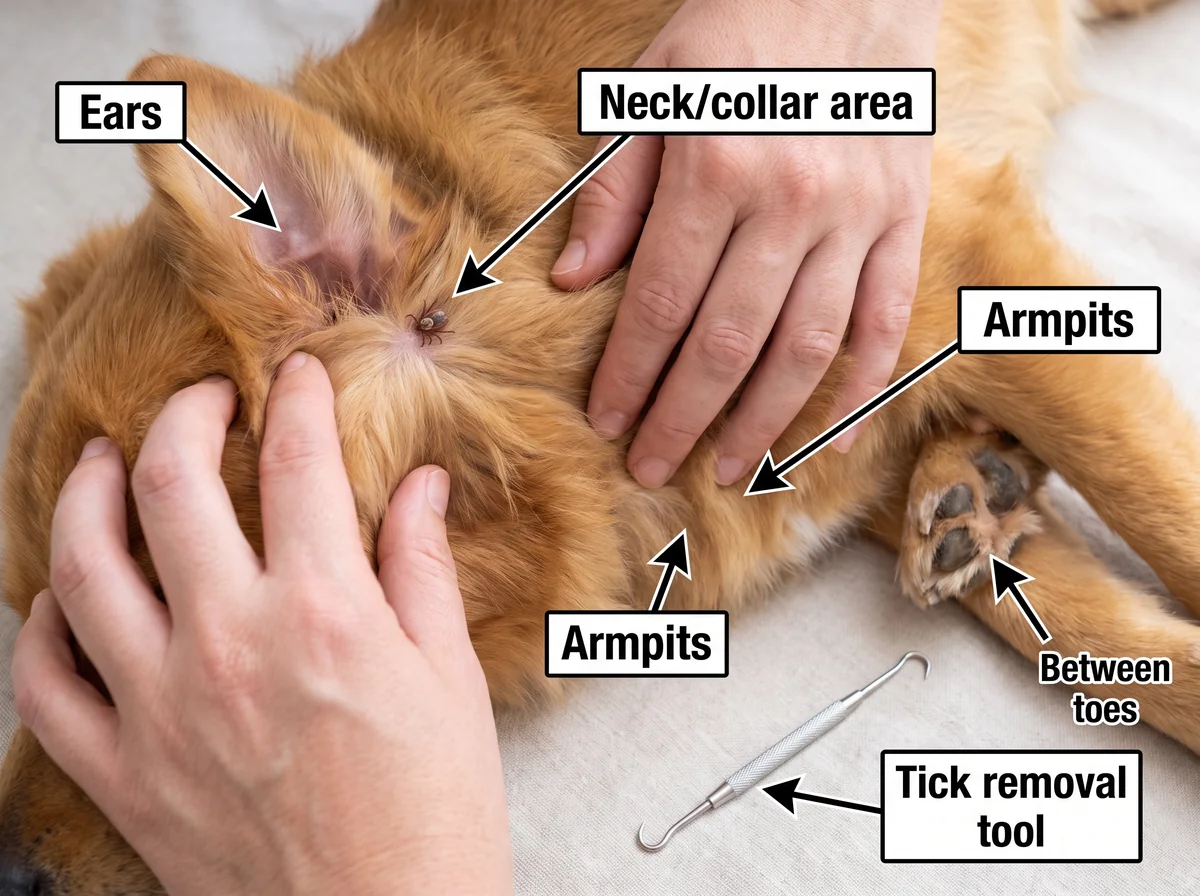
Quick identification facts
Attached Tick Removal Checklist
Use these visual checks to confirm tick presence and evaluate attachment details on your dog.
Why Does Prompt Removal Protect Your Dog?
When you find a tick latched onto your dog, taking it off right away is the safest choice you can make. Dog ticks do not pass bacteria or blood parasites the second their mouthparts pierce the skin. Instead, they feed slowly over long periods. Pathogen transmission typically requires many hours of continuous attachment rather than happening right away. Taking swift action keeps the pest from completing a full blood meal on your pet.
Every hour that passes while a tick stays anchored increases the chance that harmful organisms enter your dog's bloodstream. By pulling the pest off as soon as you spot it during a daily check, you interrupt the feeding process early. Quick removal serves as your primary defense against tick-borne illness. You do not need complicated tools or harsh chemicals to protect your dog, just a steady hand and prompt attention.
Making regular body checks a normal habit helps you catch these parasites before they become deeply engorged. When you inspect your dog right after walks through tall grass or brush, you find pests while they are still flat. Prompt removal prevents long-term attachment and lowers disease risks significantly. Your quick response keeps your dog safe and gives you peace of mind after outdoor adventures.
A related clue is covered in How to Check Your Dog for Ticks?.
Where Should You Search for Attached Ticks?
A thorough tick check requires you to look closely at specific spots on your dog where parasites love to hide. Ticks favor warm, sheltered areas with thin skin, such as inside the ears, under the collar, between the toes, and along the groin or armpits. Immature life stages like larvae and nymphs are very small, so you can easily overlook them if you only scan the outer fur.
To find hidden pests, run your fingers through your dog's coat down to the skin surface, feeling for small bumps. Larvae have only six legs and are the size of a pinhead, while eight-legged nymphs resemble tiny poppy seeds. Adult ticks are about double the size of deer ticks, but unfed adults can still hide under thick fur. Parting the hair under bright light helps you see tiny crawling or attached parasites clearly.
If you find several ticks across your dog's body, you may be looking at different life stages of a single brown dog tick population rather than multiple tick species. These ticks can live and multiply indoors or in kennels. Checking your dog from nose to tail ensures you remove every tiny larva, nymph, and adult before they settle into a long feeding session.
For the next useful comparison, see Dog Tick Bite Identification: What Does It Look Like?.
If you want a second reference, BugKnow’s how to remove a tick from a dog page covers the same topic from another angle.
What Clues Identify the Tick on Your Dog?
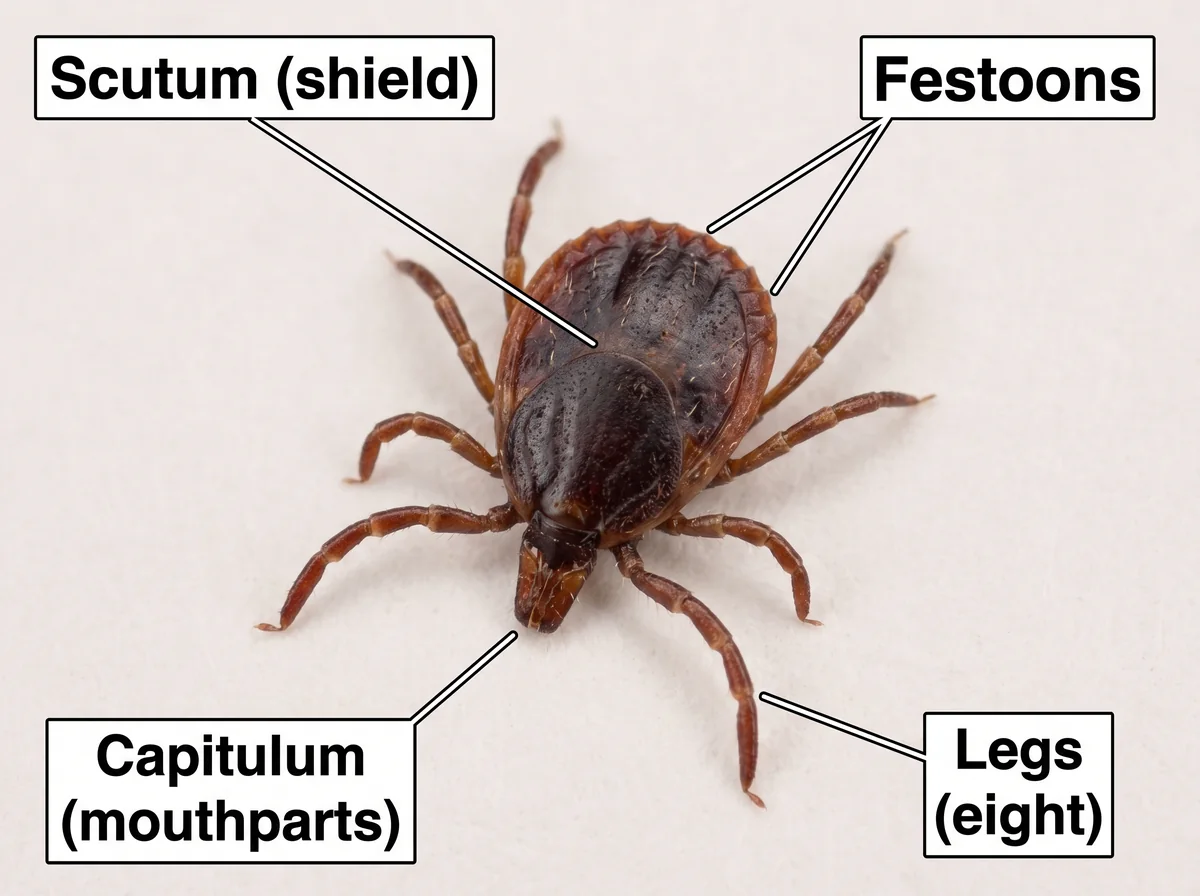
Examining the color and markings of the tick you pulled from your dog helps you determine its species. Adult American dog ticks are reddish-brown with distinctive cream or off-white markings on their backs. The hard plate behind the head, called a scutum, covers only the front third of the body on adult females. On adult males, this scutum extends over the entire back, creating a diffuse mottled cream and gray pattern.
Brown dog ticks look noticeably different because their bodies are uniformly reddish-brown without mottled cream patterns. On male brown dog ticks, the scutum covers the entire upper body, whereas on females it covers only the area right behind the mouthparts. As a female American dog tick feeds over several days, her abdomen swells until she resembles a dark, gray-brown pinto bean. Both dog tick species feature distinct rectangular grooves called festoons along the rear edge.
You can also distinguish dog ticks from look-alikes like blacklegged deer ticks, lone star ticks, and Rocky Mountain wood ticks. Neither the American dog tick nor the brown dog tick transmits Lyme disease, which is spread by blacklegged deer ticks. Looking closely at body markings, size, and scutum patterns allows you to identify what was biting your pet and share accurate details with your veterinarian if needed.
For the next useful comparison, see Dog Tick Diseases: What Should You Know?.
What Health Risks Can Dog Ticks Cause?
Dog ticks can carry serious bacterial infections that threaten your pet's health. The American dog tick serves as a primary vector of Rocky Mountain spotted fever in the eastern United States and can also transmit tularemia. In rare situations, bites from American dog ticks can lead to canine tick paralysis. Rocky Mountain spotted fever is particularly dangerous, carrying a mortality rate above 20 percent in untreated cases.
Transmission risks can begin very early in a tick's life cycle through transovarial transmission. Overwintering American dog tick larvae can hatch already carrying Rocky Mountain spotted fever bacteria directly from infected eggs. Meanwhile, brown dog ticks have been identified as carriers of Rocky Mountain spotted fever in the southwestern United States and along the U.S.-Mexico border. These overlapping vectors mean dogs in many different regions face potential exposure to spotted fever group bacteria.
Brown dog ticks also transmit other harmful canine blood disorders, including canine ehrlichiosis from Ehrlichia canis and canine babesiosis from Babesia canis. Because these parasites invade your dog's cells during feeding, removing the tick within the first few hours is critical. Knowing which diseases dog ticks carry helps you stay vigilant for signs of lethargy, joint stiffness, or fever following a tick bite.
You can check the same detail against Tick or Skin Tag on Dog: What Should You Know?.
How Should You Handle the Tick After Removal?
After you pull the tick off your dog, preserve the specimen rather than crushing it between your fingers. Place the intact tick inside a small sealed bag, a lidded vial, or a container filled with rubbing alcohol. Saving the tick allows you to take clear photos of its dorsal markings, scutum, and festoons. Having the physical tick makes species confirmation much easier if your dog develops any unusual symptoms later on.
Next, tend to the bite area on your dog's skin. Wash the spot gently with warm water and pet-safe soap, or wipe it with an antiseptic solution to keep the small puncture clean. Wash your own hands thoroughly with soap and water after handling the tick. Check the bite site over the next few days to ensure that local swelling, redness, or mild crusting resolves naturally without developing an infection.
Keep a close eye on your dog's overall energy and behavior for two to three weeks following tick removal. Watch for warning signs like unusual tiredness, loss of appetite, limping, or fever. If you notice any of these changes, contact your veterinarian right away and let them know when you removed the tick. Providing your photos or the saved tick helps your vet evaluate potential tick-borne exposures quickly and accurately.
You can check the same detail against American Dog Tick Identification: What Does It Look Like?.
Related identification guides
Dog Tick Bite Identification: What Does It Look Like?
identify a fresh or healing dog tick bite mark on skin
signsHow to Check Your Dog for Ticks?
learn a practical method for inspecting a dog's body for ticks
harmDog Tick Diseases: What Should You Know?
learn what diseases dog ticks can transmit and how serious they are
faqTick or Skin Tag on Dog: What Should You Know?
figure out whether a bump on a dog's skin is an attached tick or something else like a skin tag
Frequently asked questions
Can a dog tick give my dog Lyme disease?
No, dog ticks do not transmit Lyme disease. That bacterial infection is spread by blacklegged deer ticks, which are roughly half the size of adult dog ticks. However, dog ticks transmit other serious pathogens to pets, including Rocky Mountain spotted fever, tularemia, canine ehrlichiosis, and canine babesiosis. Because these organisms cause significant illness, removing any attached dog tick promptly from your dog remains essential for their ongoing health.
How quickly do dog ticks transmit diseases to pets?
Dog ticks are slow feeders that generally require several hours of continuous attachment to transmit disease-causing bacteria or blood parasites to your dog. Transmission is not instantaneous when the bite occurs. This feeding delay gives you a valuable window of time to find and remove attached ticks during daily checks, significantly lowering the overall chance of pathogen transmission before bacteria enter your dog's bloodstream.
What if I find tiny, pinhead-sized ticks on my dog?
Tiny, pinhead-sized ticks are immature life stages, specifically six-legged larvae or poppy-seed-sized eight-legged nymphs. If you discover multiple small ticks alongside adults, your dog may have encountered a localized brown dog tick infestation, which can thrive indoors and outdoors. You should remove these immature ticks immediately using the same direct, steady upward pulling technique you use for adult ticks to prevent prolonged feeding.
How can I tell an American dog tick from a brown dog tick?
You can tell them apart by examining their colors and scutum patterns. Adult American dog ticks are reddish-brown with cream or off-white markings on their backs, featuring a pale shield behind the head on females or a mottled pattern covering males. Brown dog ticks are uniformly reddish-brown with no cream markings. On male brown dog ticks the scutum covers the entire back, while on females it covers only the front third.