Quick identification facts
American Dog Tick Visual Identification Checklist
Use this visual checklist to evaluate a tick you have collected from your pet, clothing, or skin under direct lighting.
How Do You Tell Males and Females Apart by Their Shield?
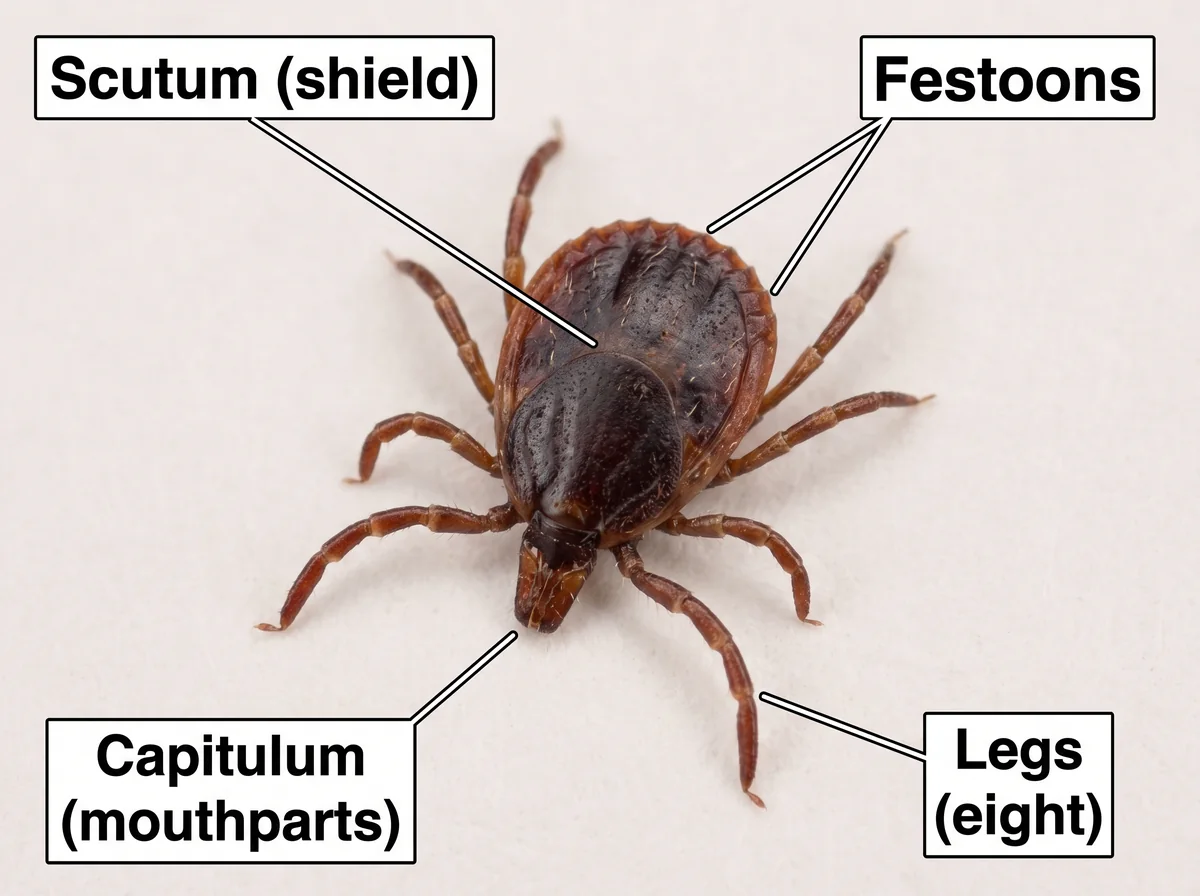
The hard plate on the tick's back, called a scutum or dorsal shield, gives you the most reliable clue for telling sexes apart. On an adult female American dog tick, this shield covers only about the front third of her body right behind the mouthparts. It features a bright cream or off-white color that stands out sharply against her dark reddish-brown body.
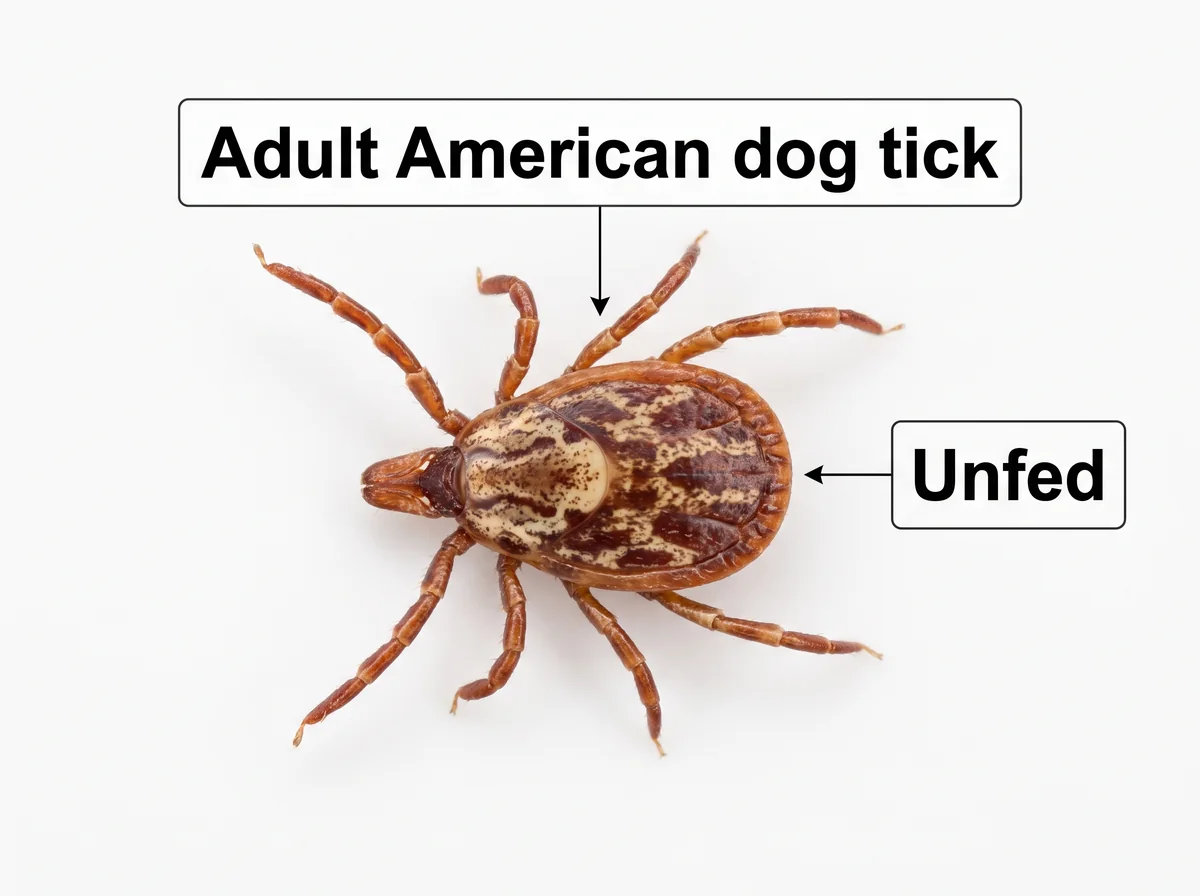
An adult male American dog tick presents a noticeably different pattern under bright lighting. His dorsal shield extends over his entire upper body from front to back, leaving no exposed lower abdomen. Instead of a single solid patch, the male's shield shows a diffuse, web-like pattern of mottled cream, silver, and gray lines across the reddish-brown surface.
Examining this dorsal shield helps you quickly confirm what you are looking at before the tick feeds. Because the female shield covers only the front third of her back, the remaining two-thirds of her abdomen can expand dramatically when she takes a blood meal. The male's full-body rigid shield prevents extensive stretching, keeping his shape relatively flat and stable.
- Female shield: Covers only the front third and shows a solid cream or off-white patch.
- Male shield: Covers the entire back with mottled, silver-gray streaks over reddish-brown.
- Unfed appearance: Both sexes remain noticeably flat before taking a blood meal.
For the next useful comparison, see Brown Dog Tick Identification: What Does It Look Like?.
What Do the Edge Notches and Body Segments Look Like?
When you view an unfed American dog tick from above, you will notice a row of tiny, evenly spaced ridges lining the rear edge of its abdomen. Entomologists call these rectangular segments festoons. They look like small pleats or decorative notches along the back rim, giving the rear contour a scalloped appearance rather than a smooth, continuous line.
These festoons remain visible on adult males and unfed adult females. As an adult female feeds on a host and swells with blood, her abdominal skin stretches outward in all directions, which gradually smooths out and obscures these rear ridges. On an unfed specimen, however, festoons serve as a dependable marker when you want to distinguish dog ticks from other tick species.
You can inspect these notches easily with a standard magnifying glass or a clear smartphone photo taken under steady light. Count the legs while you check the rear margin to verify the life stage. Both male and female adults, as well as nymphs, possess eight legs, whereas newly hatched larvae have only six legs attached to their tiny bodies.
- Rear edge: Features distinct rectangular notches called festoons along the perimeter.
- Engorgement effect: Festoons smooth out and disappear as the female tick expands with blood.
- Leg count: Unfed adults and nymphs display eight legs, while larvae display six.
This also connects with Dog Tick vs Deer Tick: What's the Difference?.
If you want a second reference, BugKnow’s dog tick appearance page covers the same topic from another angle.
How Big Is an American Dog Tick at Different Life Stages?
Size provides another clear visual baseline when you find a tick on your pet or clothing. An unfed adult female American dog tick averages about 3.8 mm in length and 2.5 mm in width, which translates to roughly one-quarter of an inch. Unfed adult males are slightly more compact, averaging about 1.43 mm long and 1.01 mm wide.
Younger developmental stages are significantly smaller and harder to spot with the naked eye. American dog tick larvae are pinhead-sized, measuring approximately 0.60 mm long by 0.40 mm wide. Nymphs measure roughly twice the size of larvae, coming in at about 0.9 mm long and 0.8 mm wide, with dark bodies that lack the pronounced adult cream markings.
To place these measurements into everyday perspective, adult American dog ticks are roughly double the size of blacklegged deer ticks, which are about the size of a tiny sesame seed. When you compare an unfed adult dog tick to common household objects, it matches the general width of a small apple seed or the head of an ordinary matchstick.
- Larva size: Roughly 0.60 mm by 0.40 mm, about the size of a tiny pinhead.
- Nymph size: Approximately 0.9 mm by 0.8 mm, twice as large as the larva.
- Adult size: About 1/4 inch long unfed, making it roughly twice the size of a deer tick.
What Changes When a Female Dog Tick Feeds?
A feeding female undergoes a dramatic transformation as she engorges on blood. Because her hard dorsal shield is restricted to the front third of her back, her soft abdominal cuticle stretches outward significantly. As feeding progresses over several days, her flat, reddish-brown frame expands into a rounded, swollen oval that looks entirely different from an unfed specimen.
A fully engorged female American dog tick can reach up to 15 mm in length and 10 mm in width, which is approximately one-half inch long. At this stage, her swollen body can weigh over 1 gram. Her coloration shifts from reddish-brown to a dull, leathery gray-brown, causing her to resemble a smooth, dark pinto bean or small castor bean.
When you encounter a heavily engorged tick, the cream-colored dorsal shield remains the exact same size behind her head, but it now looks like a tiny pale button resting against an enormous body. Recognizing this tiny frontal shield helps you identify the tick accurately, even when the rest of her body has swollen well beyond its original proportions.
- Size increase: Expands from roughly 3.8 mm up to 15 mm long (about 1/2 inch).
- Weight gain: A fully blood-fed female can weigh more than 1 gram.
- Appearance shift: Turns into a smooth, gray-brown oval resembling a dark pinto bean.
This also connects with Dog Tick Size: How Big Is It?.
How Does It Differ from the Brown Dog Tick?
Telling the American dog tick apart from the brown dog tick requires checking the color patterns on the dorsal shield. While adult American dog ticks show conspicuous cream, white, or silver-gray decorative markings, brown dog ticks are uniformly reddish-brown across their entire body without any pale mottled streaks or contrasting white shield markings.
Both species share similar structural features, including rear festoons and sexual shield differences. Male brown dog ticks possess a full-body dorsal shield, while female brown dog ticks have a short shield situated right behind the mouthparts. However, the complete lack of pale decorative pigment on the brown dog tick makes side-by-side identification straightforward under direct light.
Size measurements between unfed adults of both species are comparable, with unfed adults measuring around a quarter inch and engorged females reaching half an inch. Whenever you inspect a specimen removed from your dog, look specifically for that pale cream marbling; if the shield has prominent off-white patterns, you are observing an American dog tick rather than a brown dog tick.
- Color difference: American dog ticks have pale cream markings; brown dog ticks are solid reddish-brown.
- Shield design: Brown dog ticks lack the mottled silver-gray marbling found on American dog tick males.
- Engorged size: Both species can swell to roughly half an inch or larger after a full blood meal.
You can check the same detail against Wood Tick vs Dog Tick: What's the Difference?.
Related identification guides
Brown Dog Tick Identification: What Does It Look Like?
identify the brown dog tick and understand its indoor habits
comparisonDog Tick vs Deer Tick: What's the Difference?
tell a dog tick apart from a deer tick
comparisonWood Tick vs Dog Tick: What's the Difference?
clarify whether wood tick and dog tick are the same species and compare to other look-alikes
otherDog Tick Size: How Big Is It?
find exact size measurements for dog ticks unfed and engorged, at every life stage
Frequently asked questions
What is the fastest way to recognize an American dog tick?
Look closely at the tick's back under good light. An adult American dog tick displays an ornate, off-white or cream pattern over a dark reddish-brown body. If the tick is female, you will see a bright cream patch covering only the front third of her back. If it is male, you will notice diffuse silver-gray mottled lines stretching across his entire dorsal surface, along with small rectangular notches lining the rear edge.
Can you identify an American dog tick after it has fully fed?
Yes, you can still identify an engorged female by examining the area right behind her head. Even though her swollen body expands up to 15 mm (about 1/2 inch) and turns a leathery gray-brown like a pinto bean, her hard cream-colored dorsal shield never expands. Finding that small, pale, decorated shield sitting directly behind the mouthparts confirms she is an American dog tick rather than another large tick species.
How can you tell an American dog tick apart from a deer tick?
Size and color patterns provide clear differences. Unfed adult American dog ticks measure about 1/4 inch long, which makes them roughly twice the size of tiny, sesame-seed-sized deer ticks. Additionally, adult American dog ticks have decorated cream or off-white markings on their dorsal shield, whereas deer ticks feature solid black shields, dark black legs, and an unpatterned reddish-orange or brownish lower body without pale marbling or prominent rear festoons.
Do young American dog tick nymphs have the same white markings?
No, American dog tick nymphs lack the ornate cream markings seen on adults. Nymphs measure about 0.9 mm by 0.8 mm—roughly twice the size of a pinhead larva—and appear as pale amber or dark brown eight-legged specks. Because their distinctive adult dorsal patterns develop only after their final molt into adulthood, identifying nymphs usually requires a microscope or professional laboratory examination rather than simple visual inspection.